Just because it was animated in Japan, does that automatically make it anime?
Disclaimer:
The views and opinions expressed by the participants in this chatlog are not the views of Anime News Network.
Tubi streams Transformers and Jem.
Amazon Prime streams Tiny Toon Adventures and Batman: The Animated Series.
Netflix streams Avatar: The Last Airbender and Transformers: War for Cybertron.
Rainbow Brite and the Star Stealer is available for rent on Fandango.
Everything else is way harder to watch than old cartoons ought to be these days.
Coop, I think it’s apparent to readers that we here at This Week In Anime aren’t always about anime. We’ve got other stuff we’d like to talk about. Sure, you’ve somehow convinced the boss-lady to greenlight columns on Metal Cardbot and Baby Assassins, but then there’s me with Transformers, of course. And editor Rebecca was regaling us with her love for the old Tiny Toon Adventures feature.
© Hasbro

© 1991 WARNER BROS. INC. ALL RIGHTS RESERVED
But alas, those are Western cartoons, and there’s just no reason we’ve been able to talk about them in a column called This Week In Anime—

© 1991 WARNER BROS. INC. ALL RIGHTS RESERVED
Oh, huh.
“Tokyo Movie Shinsa”, eh? Let me do a quick search…

Well, damn.

© Image via Wikipedia
Seems that whenever they weren’t busy with the latest Lupin the 3rd caper, TMS provided the animation manpower behind many cartoons of the 80s and 90s. They weren’t alone at this either. For instance, Toei Animation was busy in the trenches of THE toy commercial shows—Transformers and G.I. Joe. In fact, Toei was the main muscle behind Transformers: The Movie, which just celebrated its 40th anniversary.
While we’re here, pour one out for Peter Cullen.

© Hasbro
But if you know me, you know I don’t…necessarily agree with that. So in the interest of compelling column discussion, I think it makes sense to revisit our mate Lucas’ irregular refrain: “Is it anime?” Who knows how opinions might…transform along the way?

© HASBRO STUDIOS. ALL RIGHTS RESERVED
But in the case of the earlier examples, it’s notable because a lot of these co-conspirators are shows the broader audience wouldn’t normally think of as anime. Transformers was produced by Hasbro, Sunbow, and Marvel Productions, by and for a Western audience, and the animation was simply outsourced to Toei, among multiple other studios from multiple other countries. As you mentioned, several other shows were made this way, though for some reason I see a lot fewer people trying to argue that G.I. Joe: A Real American Hero is actually a Japanese cartoon.

© Hasbro
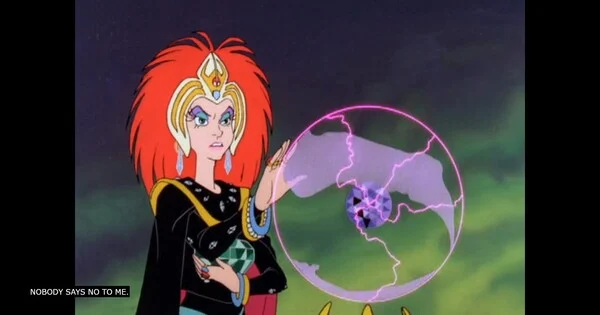
Jem at least has a magical girl and idol show thing going on, but then not nearly as many people talk about poor Jem these days.
Recent Transformers toys have done better than the languishing songstress.

© Hasbro
But yeah, having some animation outsourced to Japanese studios does not cartoons like Transformers anime make, in my opinion. But it does still make them interesting to talk about from an anime perspective! For instance, I’ll always be happy to point out that a young upstart named Masami Ōbari actually contributed to the original Transformers pilot miniseries!

© Hasbro
Of course, there’s no way to tell which specific cuts are his. Total mystery.
Not at all… Who would ever draw Optimus Prime walking pelvis first?

© Hasbro
Given the sheer number of shows that were made with said outsourcing, it can create issues with that aforementioned historical component.
Then there are projects that have truly unmistakable talents, like Mighty Orbots. While this series was conceived stateside, TMS took the ball and tossed it into the hands of the one and only Osamu Dezaki. However, he wasn’t the only star player on this team; Akio Sugino provided the character designs and Yuji Ohno popped in to score it. So, if you think this looks like “Cobra for kids,” your thoughts aren’t all that off the money. While the trio’s involvement might not have been a big deal when Orbots‘ aired, the currently in-print DVDs make a point of it.
Mighty Orbots is only 13 episodes, but it’s punching way above its 80s toy cartoon weight. Yes, the show is generally always this gorgeous.
 © MGM/UA Television, TMS Entertainment, Inc., Intermedia Entertainment |  © MGM/UA Television, TMS Entertainment, Inc., Intermedia Entertainment |
 © MGM/UA Television, TMS Entertainment, Inc., Intermedia Entertainment |  © MGM/UA Television, TMS Entertainment, Inc., Intermedia Entertainment |
It is unreal that this aired on TV the same year as Transformers.

© Marvel
“DEZAKI WAS ABLE TO BUILD THIS IN A CAVE, WITH BOX SCRAPS!”

© 2025 MACHINE DREAM TOYS
Now, Orbots being so closely a collaboration with the likes of TMS, Dezaki, and the gang does tilt it a bit more in the “Is it anime?” discussion, I’ll concede. It at least earns the consideration of “collab,” similar to the nature of what had been done between French companies and Japanese studios years earlier, with Ulysses 31 and Mysterious Cities of Gold…both of which would also be brought westward, just to mix things up further.

© DIC Audiovisuel, Tokyo Movie Shinsha

© MK Company, NHK, DiC Audiovisuel, CLT
Man, we totally missed the Odyssey hype cycle to talk up Ulysses 31.
While I do love me some Orbots, it’s hard to compete with TMS‘ greatest contribution to Western animation, Batman: The Animated Series. Over the course of its run, the series had its fair share of Japanese and Korean studios working away on the production end. A few years back, there was a particular commotion when it was discovered that a handful of Studio Ghibli staffers worked on the series. However, this excitement was quickly tamed by social media drama and classic fanboy arguing…which made it hard to nail down the exact details here.

© DC COMICS, Warner Bros. Entertainment Inc.
Never mind that specific crediting could still be inconsistent. For the Tiny Toons flick, WB gave full shout-outs to the TMS staff that worked on it. Batman? Less so.

© 1991 WARNER BROS. INC. ALL RIGHTS RESERVED

© DC COMICS, Warner Bros. Entertainment Inc.

© DC COMICS, Warner Bros. Entertainment Inc.

© DC COMICS, Warner Bros. Entertainment Inc.
So do shows like Batman, Tiny Toons, and Animaniacs only count as “anime” when they’re the nice-looking episodes animated by Japanese studios? Shouldn’t take the world’s greatest detective to figure that out.
My gut tells me that we started having the “is it anime?” conversation a lot more once anime-inspired series like Avatar hit the airwaves. Honestly, I’d bet general audiences are more tuned into the aesthetics of anime, rather than whether actual Japanese creatives worked on it. Hence the baffling talk of KPop Demon Hunters as anime.

© 2004 Viacom International Inc.
And admittedly we’re not immune to this either, as we also visited K-Pop Demon Hunters ourselves. Though I like to think we’re better about being up-front about things not being anime and the context we’re discussing them in, in spite of that. Hence, this column.

© HASBRO STUDIOS. ALL RIGHTS RESERVED

© HASBRO STUDIOS. ALL RIGHTS RESERVED
You also have companies like Netflix further muddying the waters by marketing shows that aren’t necessarily anime as “original anime,” which I alluded to with the Transformers: War For Cybertron shows…which did have their animation produced by Japanese studio Polygon Pictures, so hmmm.

The wrath of Lynzee Loveridge for invoking Transformers too much aside, I’m glad we’ve been able to discuss anime-adjacent topics. We’ve made it clear that Baby Assassins, K-Dramas, and Metal Cardbots are not anime, but they’re all part of the larger anime conversation.

© Hasbro
Unless…

© 1985 Hallmark Cards, Inc. All Rights Reserved.

© 1985 Hallmark Cards, Inc. All Rights Reserved.
Also, some other people I could curse, but I won’t talk about them.

© 1985 Hallmark Cards, Inc. All Rights Reserved.
 © 1985 Hallmark Cards, Inc. All Rights Reserved. |  © 1985 Hallmark Cards, Inc. All Rights Reserved. |
 © 1985 Hallmark Cards, Inc. All Rights Reserved. |  © 1985 Hallmark Cards, Inc. All Rights Reserved. |
And it also demonstrates how deep the rabbit hole can go when you get to investigate cross-cultural contributions in these kinds of productions. Holy crap, is that Dōga Kōbō in the credits?

© 1985 Hallmark Cards, Inc. All Rights Reserved.
It’s also worth noting that Ozamu Dezaki directed the Rainbow Brite TV series over at TMS. Even if the movie was made elsewhere, we can’t escape TMS.
 © DIC Audiovisuel, Tokyo Movie Shinsha |  © DIC Audiovisuel, Tokyo Movie Shinsha |
 © DIC Audiovisuel, Tokyo Movie Shinsha |  © DIC Audiovisuel, Tokyo Movie Shinsha |
Shout-out to the Leblanc estate and “The Wolf.”
Ain’t that a kick in the DIC?
Sorry, I’ve gotten to deploy a lot of my favorite trivia pieces here, and “Inspector Gadget is descended from Lupin the 3rd” is another one of them.
I swear, it all goes back to Lupin in one way or another.

© DIC Audiovisuel, Tokyo Movie Shinsha
All that said, yeah, I think this helps show why following up on different productions outside of Japanese anime can be illuminating and valuable to the anime-fan experience. And sometimes you just get to watch some cool and interesting cartoons in general! It’s why having a balanced media diet is important alongside knowing how your favorite material gets made, as opposed to searching for avenues to appreciate something simply because you can say it’s “technically” anime.
Absolutely! The folks behind these classic cartoons weren’t just watching other cartoons, oh no, they were loopin’ in elements from their favorite works of fiction—from books to big-screen blowouts. Maybe they had to sell a toy or two while they were at it, but that didn’t stop ’em from making some memorable moments along the way.

© DC COMICS, Warner Bros. Entertainment Inc.
Now, hopefully studying that skill so closely is enough that Lynzee won’t ask to see you, me, and Rebecca after class.

© 1991 WARNER BROS. INC. ALL RIGHTS RESERVED
We can only hope that we have the touch or power to get out of this unscathed.