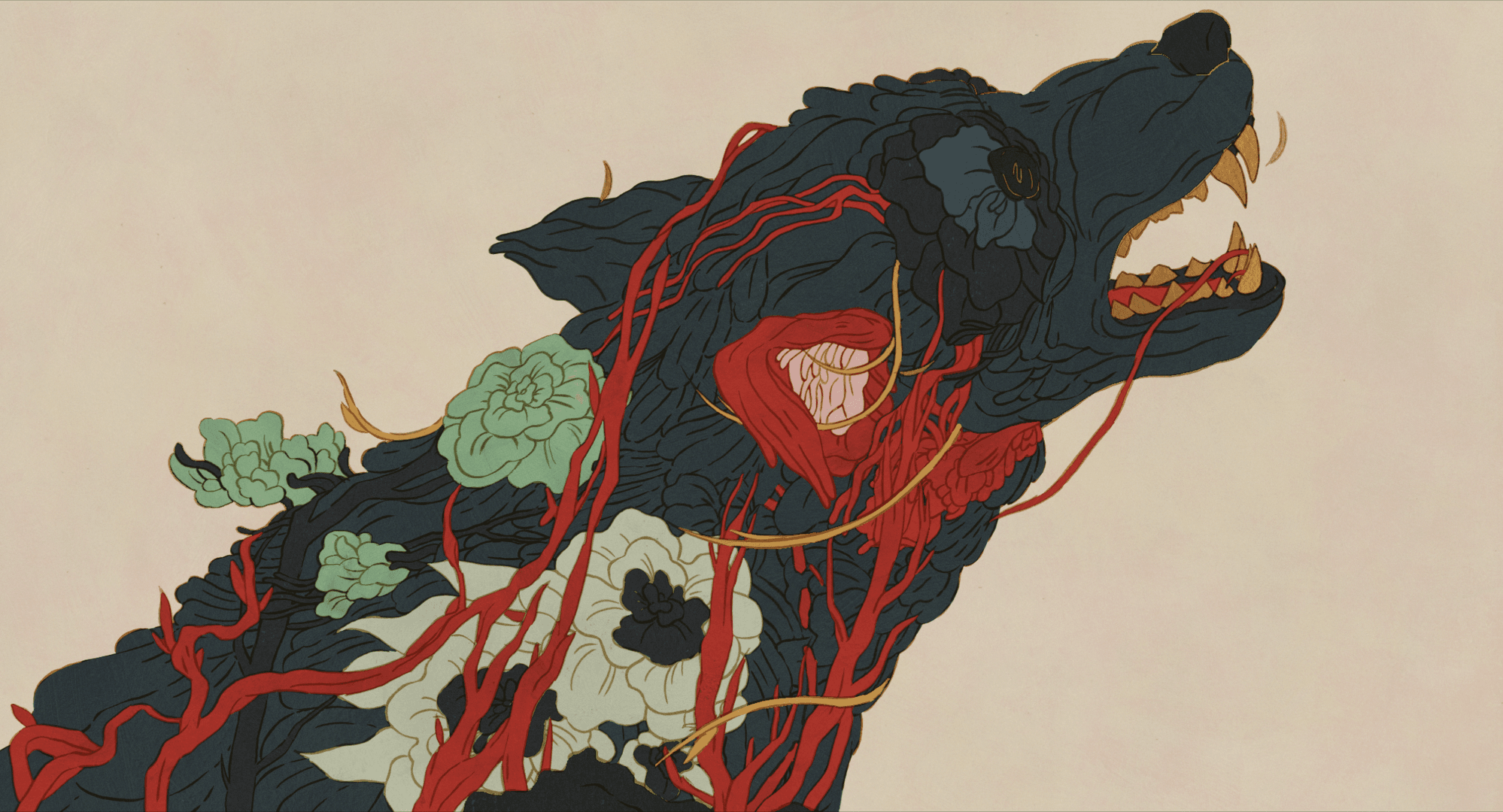
In a blog post published last February with the title “Encouraging ambivalence,” Aurelie Petit asks What remains once the moment of mobilization has passed? Rereading that phrase today, I can’t help but ask myself the same question. I was too young to be in Genoa, but not so young that I couldn’t conceive of being there. A few months later, 9/11 happened. The following year, the Florence Social Forum came and went, and was soon forgotten. The dividing line of the conflict had moved forward. New wars were brewing.
Petit’s post was about death does not exist (Fig. 1), an animated feature film by Quebec animator and documentary filmmaker Félix Dufour-Laperrière, which was screened at the 2025 Ottawa International Animation Festival and won the Grand Prize. A few months later I saw the film at DOKLeipzig. Petit’s problem with the film, and with the Ottawa curators in general, has to do with the disconcerting lack of specificity he perceived in them as political gestures. Cautiously and subtly, he insists on the implications of the “strange absence of a political reference” both in the film and in the pro-Palestinian initiatives organized during the Canadian event.
My initial reaction to the film was harsher than hers. I found it juvenile, its faux-philosophical tone closer to adolescent pretension than genuine criticism or research. Of course, most of the characters in the film are young people: militant young activists, about to carry out a violent and demonstrative attack on a wealthy elderly couple. At the last minute, Hélène, the protagonist, panics and runs away. His comrades die. One of them, Manon, reappears as a ghost and offers him a second chance. Hélène is faced with the (renewed) choice before her: remain prey or become a predator and possibly trigger change.
Millennials would have another opportunity for collective mobilization in the late 2000s, when the real estate bubble first and the financial crisis later brought to light the contradictions of the system. More cracks in the sheet metal. But by that time, the mechanisms of globalization were already in place. The horizon of possibilities had closed. Fifteen years and a global pandemic later, the latest wave of mobilization, the current one, feels as exasperated by its urgency as it is impotent by its inability to project an alternative.
Looking again death does not exist As I prepare this post, I am surprised by how private their horizon of discourse is. Hélène has a lover, one of her companions. His death, during the first iteration of the attack, is the catalyst for his personal crisis, the emblem of what he risks losing if he chooses to pursue violence: the chance at a “normal” life, meaning children and property. On the contrary, the true utopian potential of a collective revolution remains entirely abstract, reduced to a (vengeful) exchange of roles between “predator” and “prey.”