Skip to content
By Adrienne Resha
In wonder woman #1 (1986), there are men, there are women and there are Amazons. Gender, for the latter, is both irrelevant and extremely important. The Amazons exist outside the traditional Western binary of masculine versus feminine to, on the one hand, deconstruct it and, on the other, reinforce it. Even as far from the world of man as the island of Themyscira, they cannot fully escape it. Whether gods or men, not even her creators can imagine otherwise, as George Pérez and Greg Potter construct Wonder Woman’s origin story differently than William Moulton Marston and H.G. Peter did nearly half a century earlier.
As in most versions of that story, here an infant Diana is molded from clay by her mother, Hippolyta, the first and queen of the Amazons. This version of Diana is brought to life not by a god but by a goddess: it is Artemis who brings the soul of an unborn girl back to her murdered mother. Hippolyte and Diana were once victims of the comic’s prologue, but its end is near, and in this life, the reader will be able to see Diana become a woman and a heroine. But in order for Diana to become Wonder Woman, the Amazons must first become Amazons. There would be no Wonder Woman without them.
“Your gender really matters” Artemis asks her father, “Lord Zeus?” The Amazons, whose creation she advocated centuries before, “will be as no other woman never before seen by the man! Strong…brave…compassionate!”
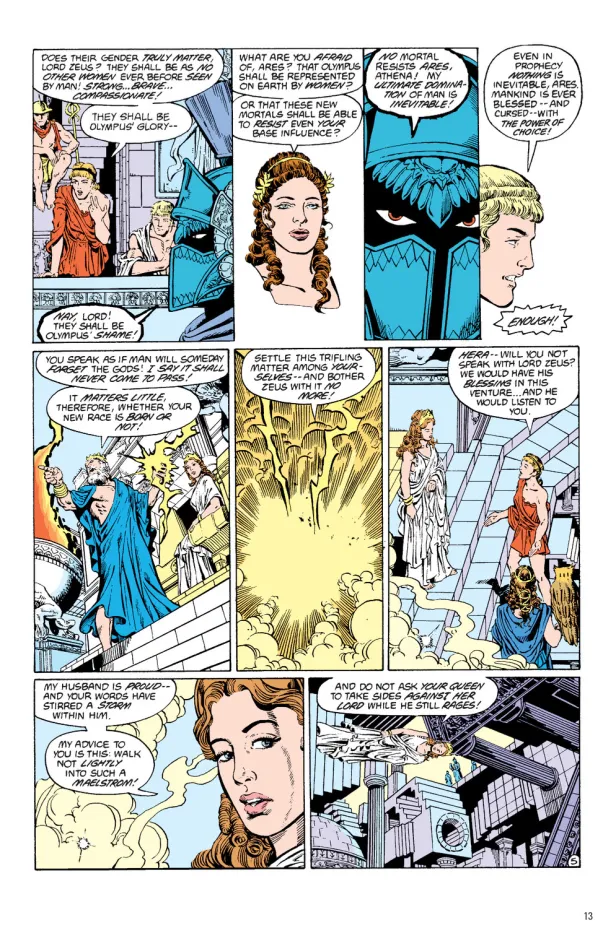
As adjectives, strength, bravery, and compassion are compared to physical traits that can be observed visually (a strong arm, a brave face) rather than traits that are not tied to specific bodies. The implication is that women are not strong, brave or compassionate or, perhaps, they are not strong, brave or compassionate. and compassionate all at once. If strength and bravery are understood to be the domain of men, then the Amazons – with their bravery, strength and compassion – will be women like men. This differentiates them from other women, but not from men… and never quite from anything else, even though they could be and are something else.
They are, to borrow from the ancient Greeks, a paradox.
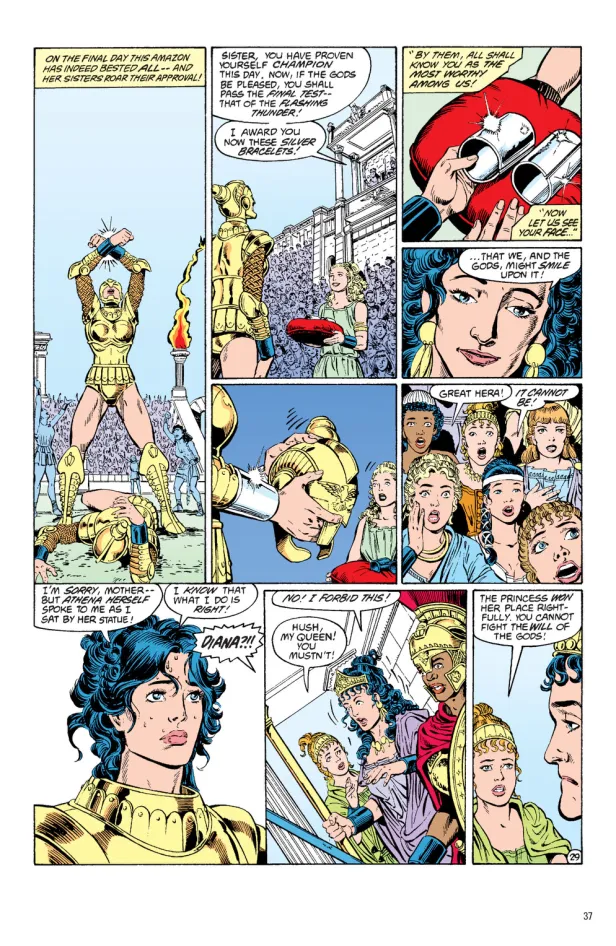
And Diana proves to be the most valuable (and most paradoxical) of them all by demonstrating both her best and worst qualities. As the Amazons compete in a friendly competition after centuries of peaceful coexistence, Diana disobeys her mother and enters the competition in secret. Even disguised in metal armor, which makes some, but not all, of her identity secret, she cannot hide that she, like every other Amazon in 1986, appears to be a conventionally attractive and physically capable cisgender woman. She is faster and stronger than her Amazonian sisters and deceptively earns their approval through anonymous feats of athletic and martial prowess.
The Amazons may not lie, but men do, Heracles does, and Diana does.
Jealous of the popularity and power of the city-state of Themyscira, which is “ruled solely by women,” paradoxically suggesting a democracy rather than a kingdom, the kings of men forced their poets to spread lies about alleged Amazonian atrocities of murder, war, and theft. Afterwards, the Amazons withdraw from the world of men. Hoping to enter his paradise, Heracles lied to Hippolyta after she defeated him in combat not once but twice. She lets him and his men in, and they betray the Amazons’ trust, burning down their homes and devastating their bodies.
Crucially, they chain the Amazons in metal, a betrayal that foreshadows the one their daughter will one day commit. The first betrayal grants men access to a world of women, which they abuse, and the second grants Diana access to the world of men, which she, as Wonder Woman, is destined to protect despite the violence to which she, her mother, and her sisters, both Amazons and women, have been subjected to by men throughout history.
According to this version of wonder woman #1, there would be no Wonder Woman without the Amazons, and there would be no Amazons without men: husbands, fathers, sons, brothers, friends, strangers, gods, writers and artists by whose hands women and girls found their ends. In this story, each Amazon (including Diana) is reincarnated from a woman whose life was “cut short” not by the courage and wisdom of man but “by the fear and ignorance of man.” Diana’s own mortal father equates fear with women, rejecting her mortal mother’s sympathy and killing her with her son in her womb. Meanwhile, wisdom (the opposite of ignorance) is not the province of a god but of a goddess, and Athena gifts it to the Amazons and Diana in their rebirths.
Unlike Diana, reborn from land, the Amazons were reborn in water.
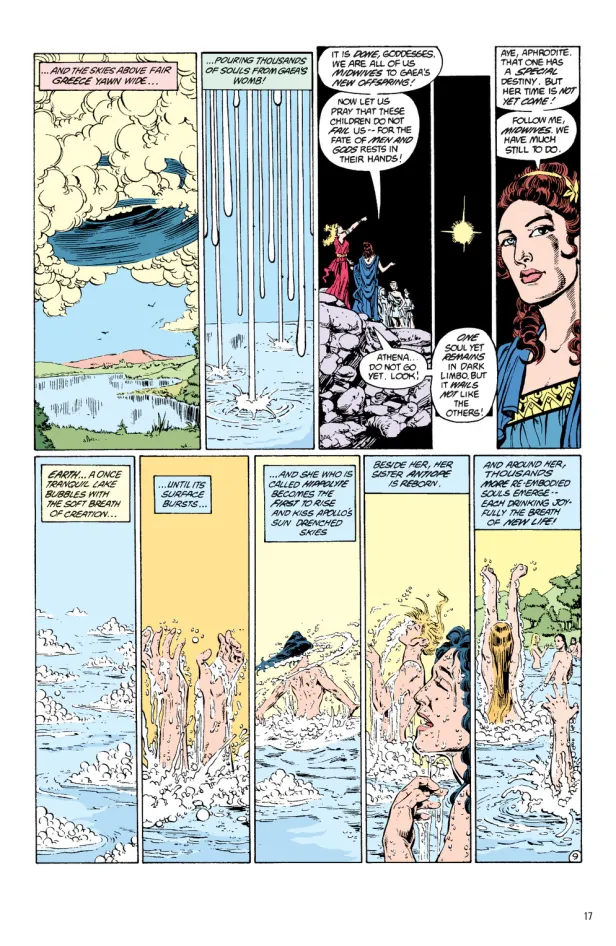
In a light blue Greek lake, wonderfully rendered by colorist Tatjana Wood, flowing under a yellow sky “bathed by the sun of Apollo,” the souls of wronged women emerge naked, seemingly perfect, thin but muscular, but not also muscular (bodies), with more hair colors (black, blonde, brunette and redhead) and textures (curly, wavy and straight) represented than skin tones. Most of the women here are fair and share the same shade of peachy pink. In reality, there are as many ways to be a woman as there are women, cis, and transgender, but in this comic, there are a limited number of ways to be an Amazon. And there are just, it seems, so many ways to be Amazon and please your creators.
Having repelled the invasion of Heracles and his men, but displeasing Athena in doing so, the original Amazons split up. Half return to the world of men while the rest retreat to what will become the island of Themyscira, a refuge and prison for both the Amazons and the evil within their paradise. After proving herself to her sisters, but before becoming Wonder Woman, Diana must prove herself to the gods by facing off against a weapon from the world of men. Facing the wrong end of a gun barrel, she deftly repels bullets with the newly won silver bracelets (similar to the chains Heracles imposed on Hippolytus) on her forearms, choosing a feminine defense against a masculine offensive.
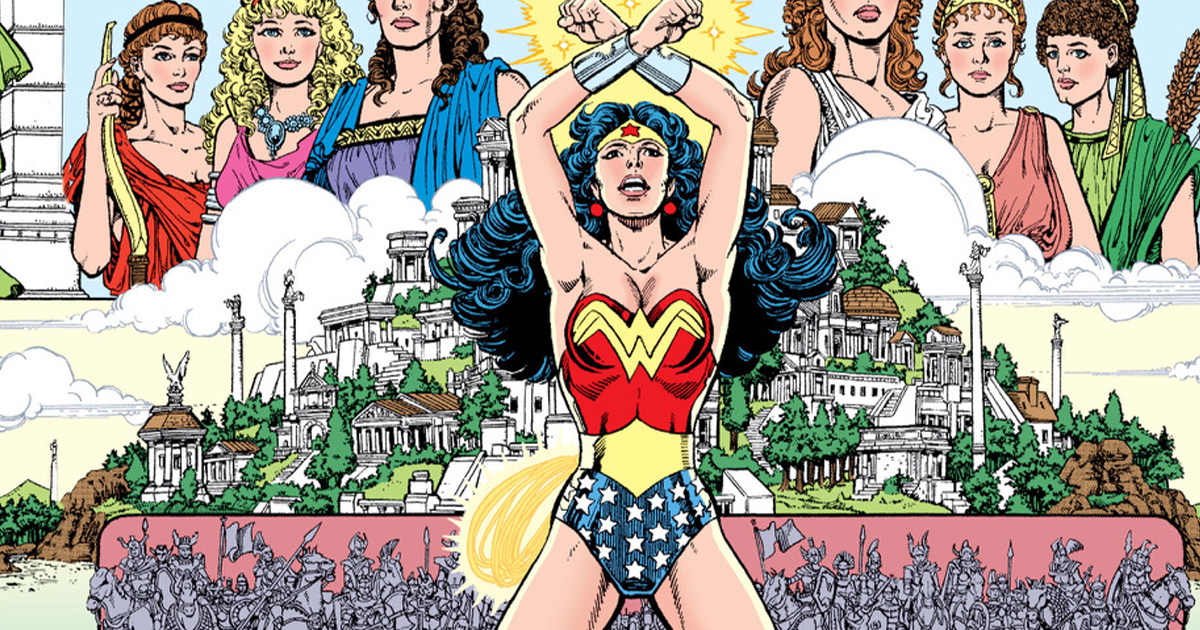
On the last page, Diana holds the jewels above her head, which is adorned with a golden tiara, emphasizing the strength of her arms over the thinness of her waist and the curves of her hips and her knee-high boots, reborn again as Wonder Woman.
In wonder woman #1 (1986), there would be no Wonder Woman without the Amazons, and there would be no Amazons without gender violence, but that is not the whole story of these women, of Diana’s story. To answer Artemis’ question, their gender does matter, but it’s not the only thing that matters about them.
The resurrections of women in Amazonas and of Diana in Wonder Woman, like the resurrection of the wonder woman title by Pérez and Potter under the supervision of editor Karen Berger, makes them different than they were before. If Marston and Peter’s Diana was a feminine figure for boys and men, then Perez and Potter’s Diana is a feminine and masculine, but not entirely androgynous, figure for boys and men. and girls and women. They may not completely transcend beyond or between the masculine and the feminine, but Diana has not yet entered the world of men, which, after all, she may discover is not just men’s.
It would be difficult, if not impossible, to go out into the world and remain unchanged, and Diana has changed, in and out of the comics, which means she can be imagined differently. and so that the reader can imagine Wonder Woman in a different way.
Wonder Woman #1 “The princess and the power!”
Conspirators: Greg Potter and George Pérez
Artist: George Pérez
Inker: Bruce Patterson
Colors: Tatjana Wood
Letters: Juan Constanza
This publication was possible thanksThanks to Shelfdust Patreon! For more information, head over to our Patreon page here.