 Skip to content

angel eggMamoru Oshii’s 1985 OVA is perhaps the best work in the director’s legendary career. The vast majority of people (myself included) would give almost anything to even one an all-time classic, a revered work that bears your name, or one that changed everything forever, or even the rare bird that somehow manages to do both. But Oshii has several to his name.
His work on the anime adaptation of Urusei Yatsura It changed television anime forever, helped fuel the otaku generation, and set a template that still informs how it looks and feels to this day. The continuation of the film, melancholic and dreamlike Urusei Yatsura 2: Beautiful Dreamer It is presented as a meditation on the lingering bitterness of aging that is as felt in 2026 as when it was published. His work adapting Mobile police patrol is rightly revered, and the institutional apathy and militarism at the center of Patlabor 2: The Movie is, sadly, more prescient with each passing year. But his most important work is undoubtedly ghost in the shell. Its effect on culture around the world cannot be overstated, a rare defining moment when nothing would be the same again. And all these are just the greatest hits; It doesn’t even cover the lesser-known titles in its catalog like Blood+ either Gatchaman either dallas (which we here at Ani-Gamers covered once), or Ghost in the Shell 2: Innocenceone of my personal favorites.
And yet, even on that impressive resume, angel egg manages to stand out as a singularly unique masterpiece. Typically, Oshii excels at adaptation, taking other people’s work and refining it into animated form. Time and time again he has demonstrated a deep understanding of issues and ideas, without being afraid to make big, substantial changes. Many anime otaku have had the surprise of going from ghost in the shell tonally very different film Original manga, a work that is usually an ecchi comedy with spider tanks. But it’s that ability to adapt that makes most of Oshii’s work more accessible, providing a solid foundation for his explorations of philosophy and society. On the contrary, angel egg It lacks that foundation and as such is often considered difficult work. It is deeply surreal, therefore very open to interpretation, and, in stark contrast to the dialogue in much of Oshii’s work, contains very little dialogue between the two unnamed characters.

angel egg being so open to interpretation also makes it difficult to argue. A plot summary doesn’t really say anything significant about the film and remains divisive to this day. My screening left people immensely dissatisfied, an experience that Evan Minto and Patrick Sutton of Ani-Gamers also had at their screening, a world away in the United States of America. Talk about the cinema being a less than ideal environment to enjoy something: certainly, most of the important media in my life was just in my room in front of the computer, or on a couch at a friend’s house with all the lights on. Inspiring this reaction is nothing new for Oshii either. Urusei Yatsura 2: Beautiful Dreamer It also had a mixed reception in its day, being sadder and less fun than the television anime that a generation of high school kids grew up on in the late ’70s and early ’80s, but emotionally honest about that high school experience in a way that reflects the sharpness of Takahashi Rumiko’s writing.
In fact, this is work that could only really be done during the Bubble Economy, that magical era where the booming home video market demanded media to put on VHS and, of course, a single piece of land in Japan was valued more than all the real estate in the state of California, really and truly forever and ever (and definitely won’t plunge the country into an economic malaise that persists to this day). Oshii has said several times that his financial failure affected his ability to get a job sooner. Patlaborand while it’s true that he didn’t have a major project for a while, he was working on television anime before, during and after its release, and I can’t help but feel that it was a very different economic reality than what animation faces in the 2020s.
The film has always struck a chord with me, from the first time I saw it to when I saw it this year. Its vision of expansive, empty wastelands where two unhappy characters fail to make a connection is uncomfortably, wonderfully so. The trauma, all the terrible things that happened are hinted at and left unsaid: instead, you feel them. Many works from this era deal with the death of the brilliant space utopianism of the space race of the 1950s and 1960s, where the miracle of spreading across the stars only adds to our problems, not solves them. It’s as much science fiction as anything else, sharing DNA with the senseless violence of the Zentraedi who effortlessly destroy Earth. Super Dimension Fortress Macrossor the famous fallen colony of Gundam mobile suit. It is the abstraction of science fiction taken to the extreme: the FTL disk is always a box that says MAGIC! in him, and in angel egg that box is everything, and makes up not only the technical or narrative details, but also the entire mood and feel.

To project a bit, it seems that Oshii’s bifurcated feelings develop between the two characters, his cynicism and his hope. Seeing that the revolution did not materialize after the Anpo protests (in which Oshii himself participated), and that everyone went back to what they were doing before, he could be more explicit in dallas but here its invincible misery is felt more clearly. I like to say “I contain multitudes” because I think we all do, and I have never seen this reflected so clearly as in angel Egg. I often feel like the nameless girl, desperately clinging to hope long after the end has already happened, trying to carry it with me and protect it as best I can, because it is important in a way that is impossible to put into words. I often feel like the anonymous soldier, jaded and quietly cynical in the face of a world that has failed me time and time again, the only voice of reason without blinders, able to see the world for what it really is and how bad things are. The repeated question at the center of the film, “Who are you?”, is something I ask myself often, as I often feel like I’ve put on so many masks over the years, for work, for friends, for family, that my sense of identity ceased to exist.
That projection, putting your own feelings into a work so determined not to give clear answers, is probably the difference between loving angel egg and leave the screening dissatisfied. I often warn people against what I call “A equals B” readings of any work, where one element can be used as a substitution cipher for a completely normal narrative or thematic point. To the extent that something in the film is intended to “mean” or “represent” something about the intent of its creators, it matters less as a puzzle you must solve and more as something you can imbue with meaning. When the soldier destroys the egg that the girl protects with the crucifix-shaped object she carries throughout the film (one of the few moments that provoked a response in my screening), he does so for no reason that the film wants to make explicit, inviting you to project onto him the reasons why you think he did it.
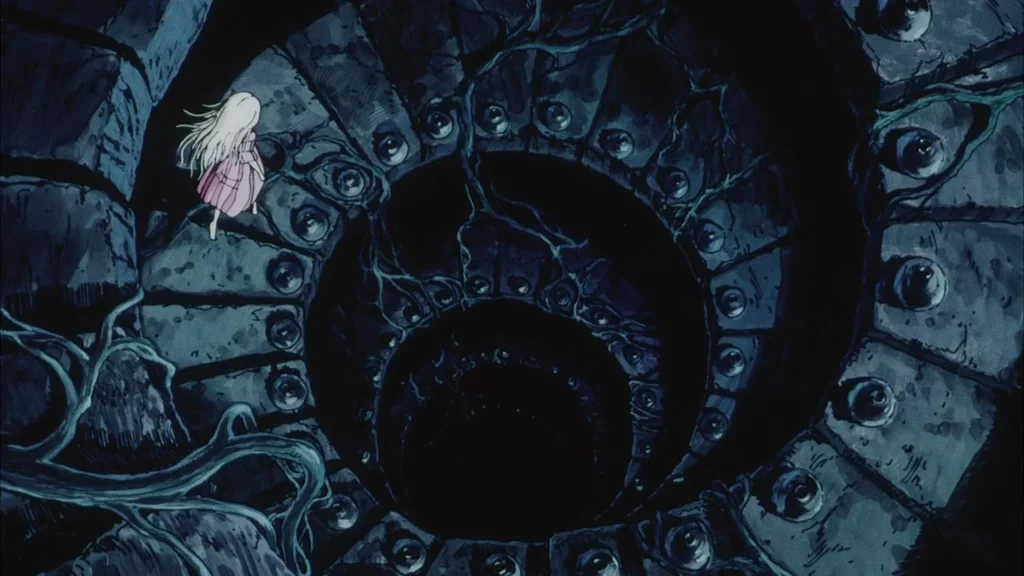
Above all, angel egg is deeply and sublimely sad, in a way that feels more and more real with each passing year. In the 1980s, everyone imagined the end of the world as a giant nuclear fireball. On the contrary, the apocalypse of angel egg It is that of water, precious and dangerous in equal parts. While I have no doubt that they didn’t intend to make a film about climate change, it still manages to evoke deep climate fear like no other work I’ve experienced. Fire consumes, dissipates and finally ends, but water is inexorable. The dank, baroque European cityscapes are completely empty, and the deployed meat tanks find no obstacles or enemies to fight against. The soldiers cast their harpooned fishing rods at the shadows (which are clearly coelacanths, often called “living fossils”), seemingly oblivious to the fact that they are not actually there. It’s clear that what happened here ended a long time ago. It feels exactly like watching climate change slowly and inexorably destroy the planet, and the lack of resolution to the film’s themes is what it feels like to try to explain to my parents why I try to avoid driving a car, why I always say I don’t have much hope for the future.
The cinema I saw angel egg This is, by virtue of a historical accident, in a fairly exclusive area, the kind of place that decades before I was born was considered a rough-and-tumble working-class neighborhood, but is now the kind of neighborhood you can only afford to live in if you have access to generational wealth. It has that particular combination of popular nightlife and old-fashioned narrow streets, the kind that aren’t designed for more than one or two cars, and certainly don’t have the voluminous internal combustion engine car traffic that it has now. One of the local stores even has the horse cart they used to deliver from proudly on display now out front. That is, people who put their personal status into expensive cars usually drive down the streets speeding up enough to be heard at the movies. This happened several times while watching the movie, the ugly, cacophonous death rattle of an idling petrol engine turning into a roar as soon as the lights changed, something I couldn’t see but knew from the context of the noise. I watched the movie and am writing this during the global oil crisis that began in March 2026, and every time I heard those engines it reminded me of the soldiers in the movie, haplessly throwing their harpoons into the shadows. It’s over: you just haven’t realized it yet.
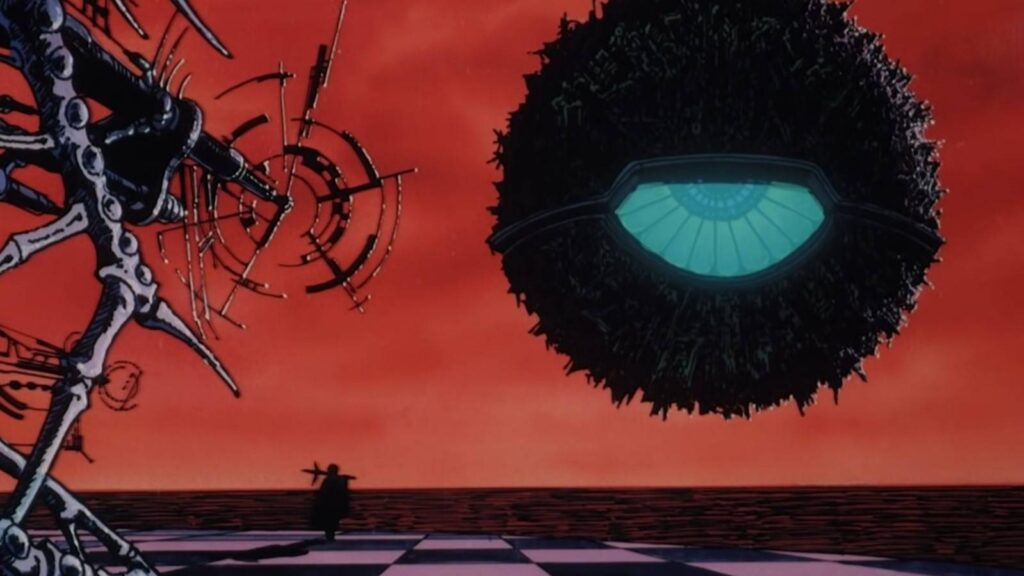
A great work will always be there for you when you need it most, and in 2026 angel egg It’s even more resonant to me than when I first saw it many years ago. I don’t necessarily recommend seeing it in the cinema, although I’m glad I went, but I’m convinced that being around other people doesn’t make it better. And, for what it’s worth, it earns its reputation as a divisive work. If you haven’t seen it, you probably already know from my description whether it’s your specific cup of tea or not. But they’ll still be nostalgic for the ’80s long after I and everyone I know is dead, and it will never, ever be the ’80s version in angel egg.