Chris and Coop hold a post mortem at the end of the 2026 con season about what, precisely, makes for a good panel.
Disclaimer: The views and opinions expressed by the participants in this chatlog are not the views of Anime News Network.
Chris
Well, Coop, that’s the 2026 anime con season basically in the bag! Good times were (mostly) had by all, although I know the members of the ANN staff who worked coverage of those really worked for it. Y’all are more powerful than me.
Thank you everyone for joining your fellow Otakon guild members this past weekend for another memorable, record-breaking year of 47,049 attendees! Our adventure has concluded, and we hope you’ll join us for a spooky summer celebration, August 6-8, 2027. #Otakon2027 #Summerween
[image or embed]
— Otakon (@otakon.bsky.social) August 3, 2026 at 4:01 AM
That said, I didn’t do nothing while we were at Otakon a month ago! You, Sylvia, and I convened for the first-ever in-person iteration of the This Week In Anime live panel, and it went off pretty well! And, as these things do, it gets us thinking: we’ve talked about conventions plenty of times here before, but now that we’re esteemed panelists ourselves, what can we say about that staple of the events? What puts on a good panel? What even should a panel be? I say we give this a rundown, and if there’s time left, we’ll fill it out with a Q&A session.
Coop
We’ll even end it with an in-joke that’s highly specific to this column, Chris!
Ah! That’s right, we used to talk of a Transformers column last time…
I’m still working up my pitch to Lynzee for that (to say nothing of appealing to Hasbro for more releases of Transformers anime we could work with…), but regardless! Panels are a pillar of the con experience, and they can span quite the variety in their subject matter and presentation. Ours was powered by tapping into the conversational nature of our column itself, an energy I’ve seen in other multi-host panels where they pick their brains on a specific subject. But for my money, the “basic” panel I think of is a host or two going over a particular subject. To varying degrees of seriousness.Edited by Megan DeYarmanEdited by Megan DeYarman
Big ups, btw, to our mutual pal and experienced panelist Megan for okaying use of some of her uploaded Anime Lockdown presentations as examples.
Outside of the convention’s guidelines and amount of stage time you’ve been given, the structure of the panel is up to you. Trying to strike a conversational or academic tone? Are you showing clips or keeping it to stills? Looking to create an esoteric piece of performance art? Or are you like our good buddy Kurt and want to rank some ugly giant robots, but do it arbitrarily?Edited by Kurt
The panel room is your oyster.
But to your point, Chris, a classic panel-ass panel tends to be a sole host getting into the weeds of a particular subject. However, the open-ended nature of putting a panel together still applies.
In fact, you have a little experience in running a one-man-panel show, right?
I do! Not to be goaded into soft-pitching my own specialized subjects, but I’ve got my “Transformers: Anime in Disguise” panel going over the Japanese-media history of the Robots in Disguise, which I’ve presented before at Fanime! And most recently, for friends in a room party at the aforementioned Otakon. Remember kids, even if the con itself unjustly rejects your pitch, you can always petition a pal to let you expound to a bewildered room of buddies.Edited by Christopher Farris
Having put this sort of thing together, along with seeing all the work you’ve done for our TWIA panels, gives me a good appreciation for the amount of research, writing, and slide-cobbling that goes into something like this! Finding an arc to keep the storytelling of the panel moving takes work! I like to fill out the beats with stupid meme edits, myself.
Edited by Christopher Farris
A good meme keeps the momentum going!
Regardless of how many people are running the panel, it’s difficult to keep a panel moving. However, I can easily imagine how hard it can be to keep yourself on pace without someone occasionally nudging the conversation along. People love it when the panelist goes to town on their subject, but they might not stick around if the panel focuses on a single point for too long or is feeling a little dry. To a degree, you’re also fighting for attention at a con. Especially when you’re booked against big events like the premiere of Magic Knight Rayearth or the official Kaiju Girl Caramelise panel—like we were at Otakon.
This is why I tightly script out my panel and stick to it: less worry about going over or under time. Though I could probably rock at least a few answers to Transformers-related questions if I needed to…Edited by Christopher Farris
To your point about those big events though, that brings up the counterpart to fan-produced panels like ours: the almighty official industry panel! Some of these can be big deals, especially at major shows like Otakon. I can hardly blame people for being drawn to the Magic Knight Rayearth panel, promising as it did an advance premiere of the new anime plus guest appearances by voice actors.
We’re cute, but I don’t know how well we can compete with Rumi Ōkubo and Yoshitsugu Matsuoka…
Based on the rock-solid crowd we drew, I’d say the competition didn’t CLAMP down on us too badly. Then again, we were there as ANN representatives, meaning that we probably had certain benefits that the average panelist didn’t. For example, the fact that we could advertise the panel within this column beforehand. That isn’t the case for most people.
But I’ve also been on the “advertise it yourself on social media” side of things too (which has its own, similar caveats involved). Back when Russell and I put on the Super Dimensional Crash Course in 2022, we got a little lucky because BIGWEST and the folks from Creative Sphere were presenting at the show as well. It probably made our panel a no-brainer for the Otakon panels team when scheduling time came around. Oh, and the two of us were also given some cool goodies to give out after the panel too.
Photo by Coop Bicknell
Again, to quote Scott Steiner, “I’m not normal.”
However, I CAN relate to how difficult it can be to PUT a panel together. How are you going to script it out? How often are you going to rehearse it? Is there a specific style you’re going for with the presentation? There are many little questions to answer before getting to the big day.
For instance, I’d bet that making your slides look and feel like the back of a G1 toy box was incredibly important.
Rustling up a clean version of the ol’ grid background was the first thing I did when building the actual slideshow. Obviously having some kind of background and history with your material is both going to inform your choice to do a panel on it and give you a head-start on knowing what info to get and where. This is one thing I like about fan panels—seeing how people’s personal interests intersect with anime discussion. I’ll always fondly remember the “Alcohol in Anime” panel I caught at ALA put on by a mixologist, and the level of insight they brought to that.
Of course, not everything needs to be tackled with such reverence. Megan’s Princess Ai panel is a personal fave, because it is an exhaustively detailed history on a…unique piece of the medium. But she tackles it with all the wry sardonicism the subject deserves, especially when it comes to your friend and mine, Disco Stu.
Edited by Megan DeYarmanEdited by Megan DeYarman
All this to say, the most important thing in the early stages of a panel is: actually know what you’re talking about!
Absolutely! If you’re not confident in your knowledge on a particular subject or research abilities, you can always step back and let it cook before submitting it to be presented. And no, having ChatGPT or Claude do all your research and slides isn’t a valid option. There was a panelist at Otakon 2025 who allegedly got caught using it, but was invited back to the show this year with the same presentation. In fact, there have been allegations of anime or game studios using AI to build their panels, and it’s never a good look. Final Fantasy XIV‘s Localization Director, Michael-Christopher Koji Fox, used AI-generated images in a recent Fan Fest panel and it didn’t go well. Even if he was perhaps trying to make a passive-aggressive jab at his bosses, that wasn’t it, chief.
I so don’t get this. As I said, tapping into knowledge to put something like this together is so much of the fun of creating a panel! Why would you rob yourself of that?
Well, there’s a reason many panelists (including us) have taken to adding “No AI” disclaimers to their panels.
If you use AI to create your panel, here’s what you’re basically saying to anyone watching: “I didn’t care about this enough to write my own slides, do my own research, make sure my findings are correct, or even bother to do any work. Oh, and I’m a plagiarist too!”
I simply have no patience for any of this nonsense, because it comes down to this—you either show up and do the work or get the hell off the stage.
I do worry about how much more of this guff we’ll have to contend with as we slog through conventions and panels in this age of slop. I’d hope that bodies like Otakon would institute more stringent standards against these things after 2025…but as you said, they didn’t inspire confidence with what they allowed back this year.
It sucks, because I’ve absolutely stumbled into low-effort panels before AI streamlined that ability to hack something out, and while those could be rough, there was at least that baseline level of craft in creating these things. Mostly. But then this is coming from someone who finds stupid cheap stuff preferable when you can deploy it. My silly Transformers meme ‘shops or Kurt sticking Bakushin O’s head on Baxingar will top any extruded AI slide any time, as far as my sensibilities are concerned.
composited by Kurt Yoder
That scrappy personalism—that’s what fan panels are about!
You’ve nailed it right there, Chris. It doesn’t matter if your presentation is a little worse for wear in some areas; it’s that you put yourself out there and did it! And if you’re worried that your panel might be even rougher than you expected, you can always poke a couple friends on Discord and ask for some feedback. Without the many great notes from our friend D-Train, Russell and I would’ve had a much tougher time talkin’ Macross. Not to mention that practice makes perfect…and also helps with the nerves, even if you’re still shaking a little onstage.
This brings up another point about getting to present the panel: you have to actually present it! Nerves are going to be a component, never mind that you will need to rehearse. I’ve got a background in drama and public speaking, so I do okay in front of crowds like this. But I know for others it can be a hard hurdle to overcome. I’ve seen those jitters. This is another thing that really comes through in experienced panelists. Someone like Kurt in particular is great at working the crowd as he actively trolls people with his arbitrary definitions of what count as “ugly” giant robots. That’s something you only get with experience.Edited by Kurt Yoder, photo by Christopher FarrisEdited by Kurt Yoder, photo by Christopher Farris
I, too, have been long-infected with the theatre kid affliction, but that doesn’t mean I haven’t felt the jitters either. Even if I’m good to go during a presentation, I can guarantee that I feel the steam rising in my head. However, it’s that experience (and lots of rehearsal, along with planning) that manages to stem that tide for me.
Before the three of us stepped on that stage, we’d gone through numerous rehearsals and made tweaks as we went. I’d also had everything laid out on a slide deck so we could easily keep track of where we were in the presentation. It all paid off, because when we did an in-person run-through, we let the panel ride, tapped into our newfound in-person chemistry (which amplified the chemistry we already had), and managed to cut down our runtime by fifteen minutes.
But again, much of that came from experience and simply doing the work.
Even a panel based on conversationalism still has to have some kind of rehearsed run-throughs! Doing this also, as I’ve alluded to, helps to ensure the panel is on-schedule for the timeslot. This is one point that makes a panel on a topic such a different animal from a written article or even a YouTube video: there’s a tight window to fill, so you’ve got to be judicious in what you include and what you cut. Hence: lots of rehearsing to see what fits…or in my case, my tight scripting meant I could at least start by calculating my word count to make sure it was hitting that hour-long ballpark.
Now granted, this sort of stringentness is going to apply less if the panel is to be less focused on straight talkin’, such as the “Awesomely Bad Japanese Music Videos” showcase Kurt also puts on, or a dedicated Q&A panel.
Or our bag of cats, which is a loosely structured convo with points we’re working through.
To be fair, that’s also this column.
That’s the magic of these kinds of presentations, that you can stage this sort of thing with just some microphones and an (if necessary, interactive) audience. Such as it is that panels can be exquisitely produced shitposts about robot attractiveness or the inherent appeal of Magikarp, or intimate sit-ins where the likes of Hidenori Matsubara is drawing requests live from the audience while taking questions. They can be a lot of things, with conventions presumably hoping for a variety of programming to appeal to so many of the attendees.
You’ve probably already noticed the lengths I’ve gone to replicate the column’s visuals in our panel, but it was also built on the back of the Macross panel’s slide backgrounds. Yes, I did go out of my way to make that panel look like a Gunbuster science lesson (shout outs to Tama for the amazing chibis!). Again, “I’m not normal.”
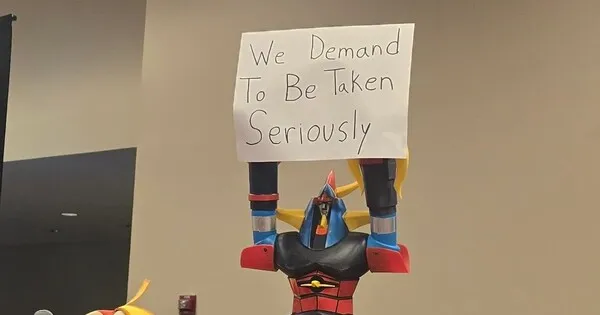
The art you got absolutely nailed it too! It’s part of the appeal of getting to do your own panel: putting your own spin on styling that presentation. I’ve seen some people go above and beyond, putting together whole quiz show panels that were powered by bespoke RPG Maker campaigns. To say nothing of bringing in additional props like Kurt having Shogun Warriors protesting his panel, or Megan having an actual copy of the Princess Ai poetry book on-hand.Photo by Kurt YoderEdited by Megan DeYarman
Maybe next time I present the TF panel I’ll have Deathsaurus or God Ginrai backing me up on-stage…
Life-size? I know a handful of Transformers enjoyers who’d love to see you flanked by two Obari-fied robots…
Look, it’s either that or present in cosplay, which plenty of us have done before. Having some kind of backup is valuable, regardless. Technical issues the day of can cause any number of speed bumps. I’ll never forget the first time I presented my panel, discovering that the display hookups for the room screens needed a different plug than what I’d packed. Thankfully, the technical ops for panelists were able to hook me up with a dongle, but still, it was sweaty there for a moment. Never mind the golden rule of convention panel tech: Don’t rely on con wi-fi! Make sure you have everything saved and ready to go locally!
As far as I’m concerned, there is no internet at the convention center.
One of the golden rules of presenting! As we’ve gone over this, I can see why the big official industry panels can be appealing: the idea of being In The Room when the next big Trigger project is announced has some draw, and lord knows some disc publishers can put on a hell of a show. Still, I hope that hitting these highlights of fan panels reminds people what they can see by seeking some of those out—to say nothing of creating their own! Fandom is a conversation, after all, and being directly in the room is a good way to have that conversation.
See, even the professionals can bring that fan-panel passion to their presentations when they want to! I love getting to hear the opportunities for these folks to really go in-depth on the specificities of their work. Reminds me of seeing Les Claypool (not that one) present a very detailed panel on his sound mixing efforts on the original dub release of the Ghost in the Shell film at that aforementioned ALA. This was a subject that was really outside my knowledge base then, but his passion for the process absolutely sold the appeal of what goes into mixing something like a “standard issue big gun.”
It’s that passion that really sings, and I don’t think a clauded-out panel generated at 1 AM the night before has a prayer of capturing that.
Yeah, you gotta give people the opportunity to cram that panel together themselves at 1 AM the night before! Not that I agree with Sakuracon’s draconian “submit the entirety of the completed panel presentation when you’re just applying” rule, but seriously folks, make sure you’re practiced and prepared when sharing your passions.
It’s always best to be SUPER LINKED and ready to go!
More about superlinking and other ways Transformers hook up in my panel! Or that eventual column…whenever I’ve finished putting that pitch together at 1 AM…