 Skip to content
Rifujin na MagonoteThe popular Isekai light novel series by Mushoku Tensei (Jobless Reincarnation) has earned quite a reputation, primarily due to the anime adaptation’s fractured reception in the press and fandom at large. Now, halfway through its third season (the second half will air sometime in 2027), fans and detractors continue to debate heatedly in forums and comment sections whenever the series is mentioned. Honestly, the endless debates from people with strong opinions on both sides are exhausting.
I certainly understand where both sides are coming from. With a few caveats, I really enjoyed the first anime of 2021. coursewhich adapts the first three novels covered in this review. the second courseaired six months later, it was also great. The problems came during the second season, with at least one scene so disgusting I almost dropped myself. franchise completely, and I fully accept that many other viewers will have left at that point and will never look back. However, perhaps against my better judgment, I persisted with the show and found the third season to be excellent enough that I went back and revisited the first few novels I initially read several years ago, shortly after the conclusion of the first season. If I can read the later sections that I hated in the animated adaptation, I hope to eventually read the entire series. I don’t believe art has to be perfect to have value, and sometimes flawed and even offensive art deserves to be analyzed and evaluated, especially if the positive aspects of the art outweigh the negatives.
Mushoku TenseiThe controversies lie in the personality and actions of its protagonist, the reincarnated boy Rudeus Greyrat. Magonote’s writing takes a “warts and all” approach towards Rudeus, with most of the novel series written from his first-person perspective, his floridly perverted desires and creepy observations towards the opposite sex completely intact on the page. We’re not necessarily expected to sympathize with Rudeus: he recognizes that his own personality is problematic and accepts, with regret, how he wasted his early life as a pornography-obsessed recluse who so exasperated his family that they disowned him. Before reincarnation, Rudeus was a pathetic and selfish individual who externalized guilt for his pitiful circumstances and lived as an emotionally abusive parasite. In a word, he was rough.
However, Magonote decides that this is the character he wants to rehabilitate over twenty-six entire volumes of light novels, and it’s certainly not an easy journey. Rudeus takes with him many of the psychological hang-ups that caused him to ruin his first life, although, to be fair, he tries very hard to try to achieve a successful second life. It helps that he is reborn into the privilege of a loving family of a lower noble class, and discovers a natural ability for magic that makes him surprisingly mastered, even as a baby. Yes, in some ways this is very much a power fantasy, although it’s not as simple as that. No matter how prodigy young Rudeus is, events often escape his control and he must deal with exceptionally difficult, even traumatic, circumstances. This is no longer some lazy isekai power fantasy where characters pull video game-style stat screens out of thin air and solve all their problems by leveling up. This world is much deeper and more complex than that.
The problems with Rudeus’ character run deep and emerge early. When he was a baby, he looked askance at his mother’s breasts. As a child, he acts inappropriately with another boy, plus he idolizes his young magic teacher so much that he steals (and hoards) her worn-out underpants. This kind of stuff really scares me. As much as he would like to try, Rudeus cannot completely hide his perverted nature. Although no one else knows that this boy has the mind of a 34-year-old man, they comment on his disturbing behavior and strange facial expressions. He knows it’s not normal and so does everyone else.
However, Rudeus is not the only character with excessively sexual motivations. The series deals with sex and sexuality as an integral part of the human experience. Rudeus describes, in almost excruciating detail, the kind of noises his parents make when they are alone in his room, and there is an uncomfortable scene in which his teacher, Roxy, is shown as a kind of voyeur. His father, Paul Greyrat, is a womanizer and this behavior has lasting narrative consequences.
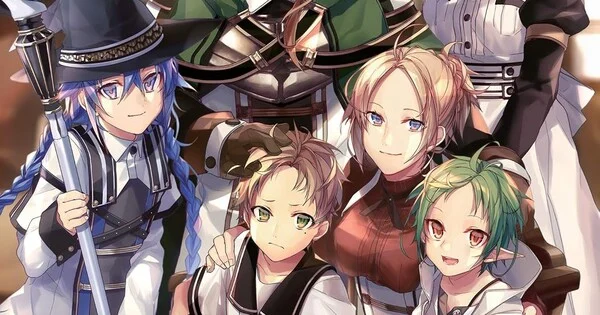
In fact, one of Mushoku TenseiThe main issue is that of consequences. Often, small, seemingly harmless decisions come back to affect Rudeus with major ramifications, even many volumes later. Maganote establishes a wealth of plot threads in these first three volumes that continue to weave a tight narrative tapestry much later. Even at this introductory stage, we hear about pivotal characters like Orsted and Perugius, and places like the Ranoa Academy of Magic. Rudeus also meets the three women who will play important roles in his adult life: Roxy, Sylphie, and Eris.
Calling names isn’t the only world-building technique Maganote employs. The “six-sided world” is a living, breathing place with a history dating back thousands of years, of wars and social development. There are multiple continents, all with many different countries and cultures that are just beginning to be examined here. The backstories we learn while Rudeus reads textbooks or listens to stories are honestly fascinating, and almost all of the foreshadowing introduced here pays off handsomely later.
Each novel covers a well-proportioned portion of the story, usually all set within a certain area. Mushoku Tensei is a grand adventure narrative, eventually reaching a global reach, though it begins intimately, with the entire first volume set in Rudeus’ family home, where he spends the first eight years of his life, being trained by Roxy and befriending Sylphie. The second volume covers the period in which he is sent to live with his extended family, to act as guardian to the wild Eris (my favorite character by far). Things really escalate in the third volume when a catastrophe strikes and the big adventure begins in earnest.
While I generally can’t stand Rudeus as a character, the richness of the world and the rest of the colorful, sympathetic cast make up for being trapped inside his puerile thoughts for most of the narrative. It is a very compelling read, and in my recent review of these early volumes, I decided to give the audiobooks a try, read by kirk cliff. His mature masculine gravitas wasn’t exactly what I expected, but he does an excellent job. I’m not quite sure how he manages to raise his voice by what sounds like several octaves to the younger female characters, but fair play to him.
To anyone who’s already decided they’re going to hate the series because of their visceral dislike of the main character: I get it. Go ahead, go read something else. For those willing to endure some moral discomfort in the service of an excellent story, this series is highly recommended. You don’t have to agree with the protagonist’s thoughts and decisions to enjoy a story, and in fact, it’s sometimes quite satisfying when comeuppance occurs under such circumstances!