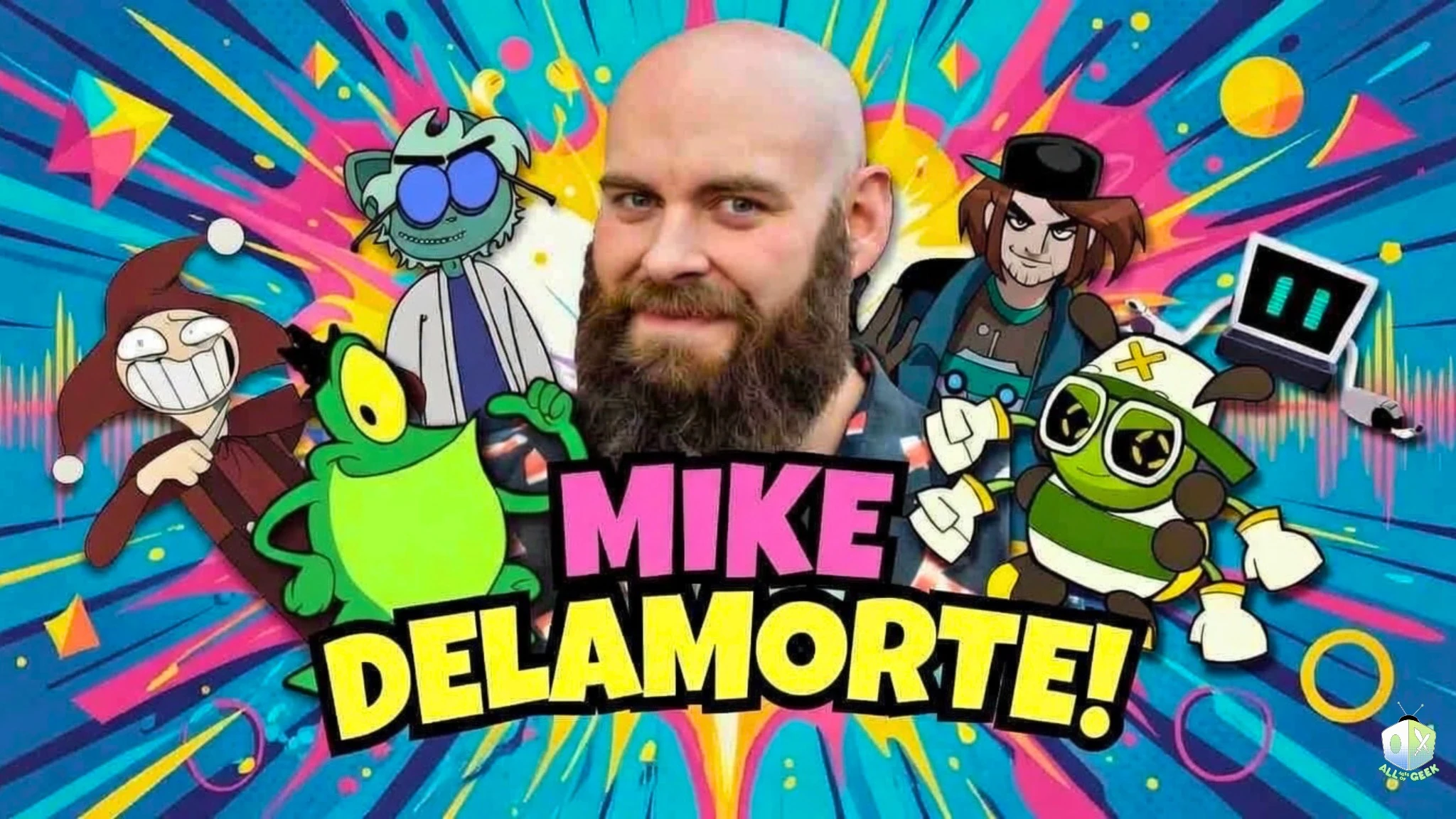
Voice actor and coach Mike Del Amorte joins us to talk about how to get started in voice acting, how to find creative purpose through acting, advice for new actors, and the joy of helping other voice actors grow through training.
1. What inspired you to start voice acting?
I’ve always loved impressions and vocal experimentation (as well as movies, animation, and video games), but it was during my time as the leader of my previous band, Glass Divide, that prompted me to begin my journey. During the course of the pandemic, we were recording a new EP to try to stay sane, and our sound engineer and longtime collaborator, Rico, had me pull out all these strange and interesting spoken vocal layers behind the shouted lines for our new batch of songs. I had already been feeling this kind of “itch” in the back of my mind for some time regarding voiceover and acting, but when I started asking Rico (he had done some work in ADR) he didn’t really have any direction for me. So I started digging into everything I could and eventually started auditioning. In fact, with the stimulus money I bought my first round of equipment. It’s funny because I’ve always been creative, but through all mediums, from illustration to music, there was this nagging feeling that there was something more important that I “should” do. It wasn’t until I plugged into voice acting that I realized this was IT.
2. What advice would you give to new actors?
Be patient. Take your time. Be diligent and yes, stay organized. But also please… be kind to yourself and give yourself the time and mental space to breathe and grow in your art. There will always be other opportunities, ALWAYS, so you can pass up a lot of them while taking advantage of the few that you really connect with. And don’t drown yourself in an obscene routine of forgettable auditions in the pursuit of chasing numbers; Being a good actor means giving yourself over to a process that requires time, concentration and real energy to connect with the readings and develop characters worth listening to. We don’t like machines taking over our art, right? So don’t forget to be human 😉
3. What has been your biggest success story so far as an actor?
My biggest success story as an actor is finding this creative outlet and, despite so many challenges, continuing to stay the course long enough to see things blossom. Honestly, I had a pretty rough start in life and had to do a lot of internal emotional work on my own to catch up and become a “functional adult.” The art as a whole has always been central to that, but voice acting has helped me heal and grow in wonderful ways, while also having the opportunity to give back to others in the process. I can recover part of my childhood in the work of some of the characters. And being able to see my stepchildren enjoy the things I help create is extremely special.
4. You also do coaching! Tell us about it
Yeah! Coaching is something I started doing this year and it has been an incredible experience, both for me and the voice actors involved. Although I initially started with a basic methodology that worked for me, my approach to teaching has adapted and evolved a bit as time has gone on. This is an idea I inherited from my time as a martial arts instructor, but when teaching students, I also learn from them, generating new ideas and approaches to direct reading. There’s something about having to communicate and orient yourself quickly and on the fly, especially with students of different styles and abilities, that really helps develop those fast-twitch mental muscles. I also love to see that in many cases, the voice actors I have worked with become shortlisted and booked using these methods, which is very satisfying for everyone. Your victories are my victories.
5. What are some of the things you discuss with other actors in your courses?
A lot of my focus is on character work and crafting better auditions, both from a performance standpoint and also from a marketing standpoint. I think auditions are a great place to focus, because the skills you learn from taking short sides and expanding them into scenes with fully developed characters will absolutely help you with your work once you’ve booked the role. On the marketing side, it’s about considering the experience of the casting director, whose ear is probably about to fall off after listening to hundreds of auditions, and making bold decisions that will get your takes to the top of the list. Voice actors have a lot of freedom in the audition process, and there’s a lot of creative room for you to come up with a pitch for a character that’s fun for both you and the listener. The bottom line is: you don’t get compensated for doing all these auditions; Why wouldn’t you find ways to have fun recording them? Making the process fresh, fun, and exciting for you is also about creating habits that will keep you engaged and prevent burnout.
6. Where can people support your work?
Follow me on X and stay tuned! I have some ongoing productions and games that I have been a part of and provide links for. There are also some upcoming pilots, including parts of Detective Jake, Hard Evidence, and Alfred Around The World that are in the works, and I’m excited to share news about them as they emerge 😀
—
Do you want more interviews? Check out our interviews page!

Have fun with us!
I married a monster on a hill (Award-winning series)
Fact sheet
Patreon
Social