Comics
28th September 2026
After the acclaimed Judge Dredd: A Better World offered us the potential of Mega-City One transformed, writers Rob Williams and Arthur Wyatt and artist Henry Flint return for Judge Dredd: The New Future, a spectacular new Dredd series that kicked off with a Prologue in 2000 AD Prog 2500, and began for real in Prog 2501.
Just as A Better World was something very special, a tale of hope and genuine change brought down by baser political motivations, The New Future already looks like it will be every bit as important and impressive, right from the very start. Expect taut storytelling, politics aplenty, and a new threat for both Dredd and his city here as the fallout from Maitland’s sabotaged experiment unfolds. All that, plus some of the very best art of Flint’s already storied career. Expect something absolutely incendiary.
So, with major things happening, we sat down to chat with Rob, Arthur and Henry. Although, seeing as Henry’s still finishing the art for the series and Tharg’s busy cracking the whip, he could only hang around for the briefest of times. When he’s finished the art – and oh, what art it is – we’re hoping to get together and chat with one of the finest Dredd artists in a little more depth.

You’ve got Judge Dredd: The New Future beginning its run in Prog 2501 after giving us an intriguing Prologue to it all in Prog 2500. It all comes 128 Progs (if my maths is right) or roughly two years in Dredd time after the end of A Better World and the tragic culmination of Maitland’s quest to solve all of Mega-City One’s problems through making the city, well, A Better World.
First of all, better to get it from the horse’s mouth so to speak – all three of you – what is The New Future all about and what can we expect from the 12-part series?
ROB WILLIAMS: In some ways it’s a sequel to A Better World but in all the ways that count it’s a continuation. At the end of A Better World we had some plot threads left dangling, some pretty substantial crimes unpunished and a reckoning promised – both for characters and the City. Spoilers here – but as you read in the prologue, Dredd is pretty certain he knows what Judge Hernandez has done; now he just has to prove it – not easy when we’re dealing with the Head of Street Division. And Hernandez sees weakness at the top of Justice Department after the fallout of the Maitland experiment and knows this is his chance to take what he wants. Something’s got to give.
ARTHUR WYATT: In A Better World we saw what happened when the City was given an opportunity to change for the better, and avoid the grim cycles of events it seems perpetually locked into… that opportunity was rejected about as thoroughly and violently as could be, and that future closed off, so now we see what happens in The New Future.
HENRY FLINT: I think I know what it’s all about but I really don’t. It’s like a rabbit hole. Sometimes I think it’s how political figures can get away with anything if the public are stupid enough to believe them, but then it changes direction, and Rob and Arthur are telling completely different stories about other things equally disturbing.
[And that, dear reader is the moment Henry’s politely reminded by Mek Quake that he has his daily page count to hit. Somehow, Mek Quake’s even more terrifying when he’s polite. So that’s where Henry has to leave us. But like we say, we’ll hopefully catch up with him in a few weeks to talk more about all that incredible art he’s making here.]
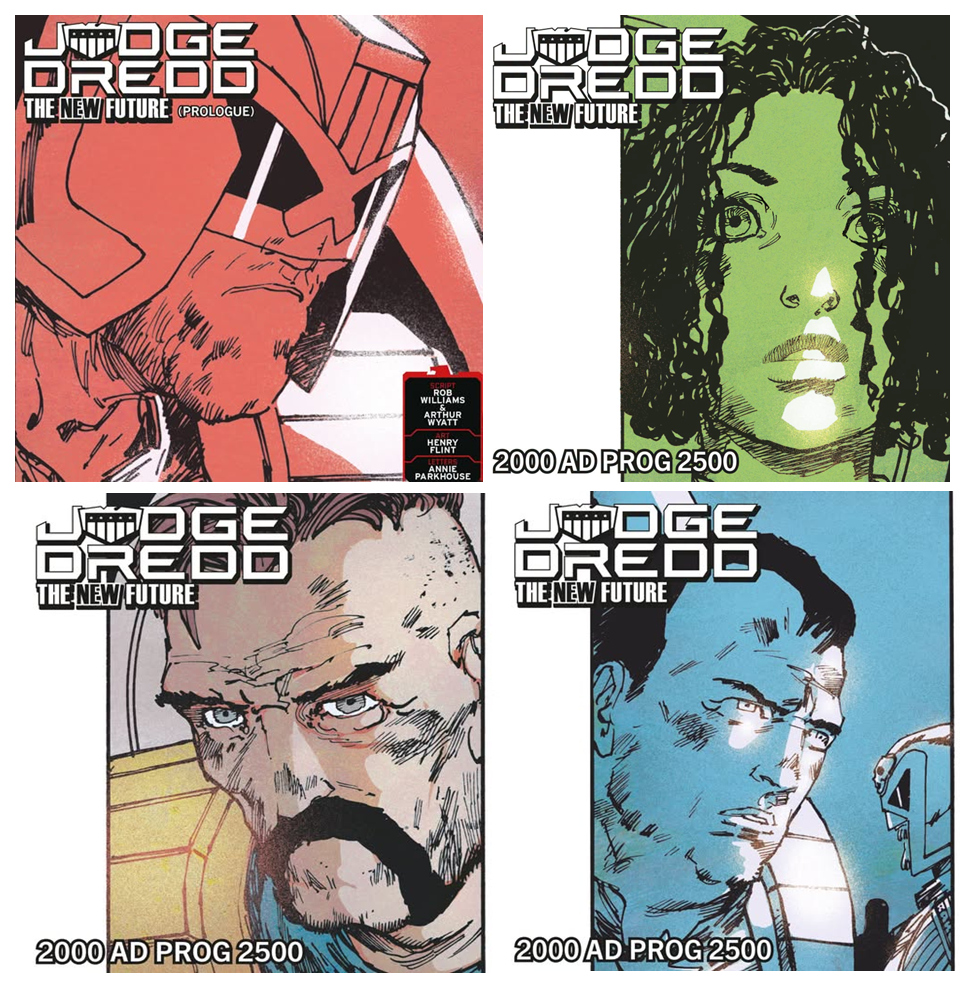
In those first two parts of The New Future – the Prologue and Part 1 – we’ve seen the aftermath of Maitland’s failed utopia, brought down by the very things she just couldn’t factor into the data and the figures she was running.
So, first of all, let’s head back to A Better World. It was both a radically different sort of Dredd in the prospect of upending everything we know about Mega-City One, and yet something that Dredd’s always done — very political and very much reflecting the things we see happening around us here and now in the real world through the lens of Mega-City One.
And all of it directly relatable to events happening in the world around us right now – and then – the idea of a controlled media, not by the state but by the rich and powerful with influence and a single-minded vision willing to manipulate events to pursue their agenda. It’s a classic sci-fi thing, a classic Dredd thing, and it’s done so well – so much so that we could all see just what was happening in the story long before Maitland saw it coming.
AW: The initial seed of A Better World was in Rob and I both using the character of Judge Maitland in stories and me being interesting in collaborating on something using her. I think I had some reader comments about various Dredd writers sticking mainly within their own sandboxes in mind and wanted to break out of that a bit. Meanwhile, Rob was just wrapping up End of Days, one of those stories where the city faces a big cataclysm, and had an interest in doing a story following up on it so that the city didn’t just leap straight back to normal.
So we got Carry the Nine, a story in which a keen analytical mind studies the fix the city is in, and which the city keeps getting itself into, and comes up with an alternate way of doing things… This of course, was being written during a period of plague and civil unrest in the real world, and also a time when alternate ways of doing things were gaining some ground, and we saw the new civil rights movements like Black Lives Matter movement, as well as the anti-carceral movement and police defunding all gain ground and prominence, moving from the fringe into to the mainstream.
Judge Dredd is capable of operating in many modes, and one of them has always functioned as a way of looking at society and a lens into how society works, so of course ALL of that becomes grist for the mill.
After that, it just felt like the story had some natural hooks for another story, so we kept it going, all the time keeping an eye on events in the real world. After The Hard Way, when I think we really set the shape of what would become A Better World, the level of pushback and opposition to Defund was really becoming apparent. Especially post-Trump losing the political establishment, and the media absolutely LOATHED those ideas and wanted them gone as soon as possible, which was fascinating.
I think also the very natural shape of the story became a tragedy, and tragedies tend to end the way they do, so sure, I’m pretty sure the arc of the story was apparent to readers long before it was apparent to Maitland.
And of course, because it’s 2000 AD everything has to be a little over the top, and a little funny, and everything needs to be done with flare… so we knew our culminating story had to be done with Henry Flint.
RW: Oh, absolutely. Putting a mirror up to the world and the fears and themes that threaten to overwhelm has always been part of sci-fi, and Dredd’s a sci-fi strip at its heart. I guess my one little niggle with A Better World is that it reflects what’s going on in our society right now. Dredd, and John Wagner and Alan Grant, were so brilliant at predicting what the future would bring and delivering it in dark satire. The fact that the real world has caught up with Dredd’s authoritarian, surveillance state is more than a bit worrying.
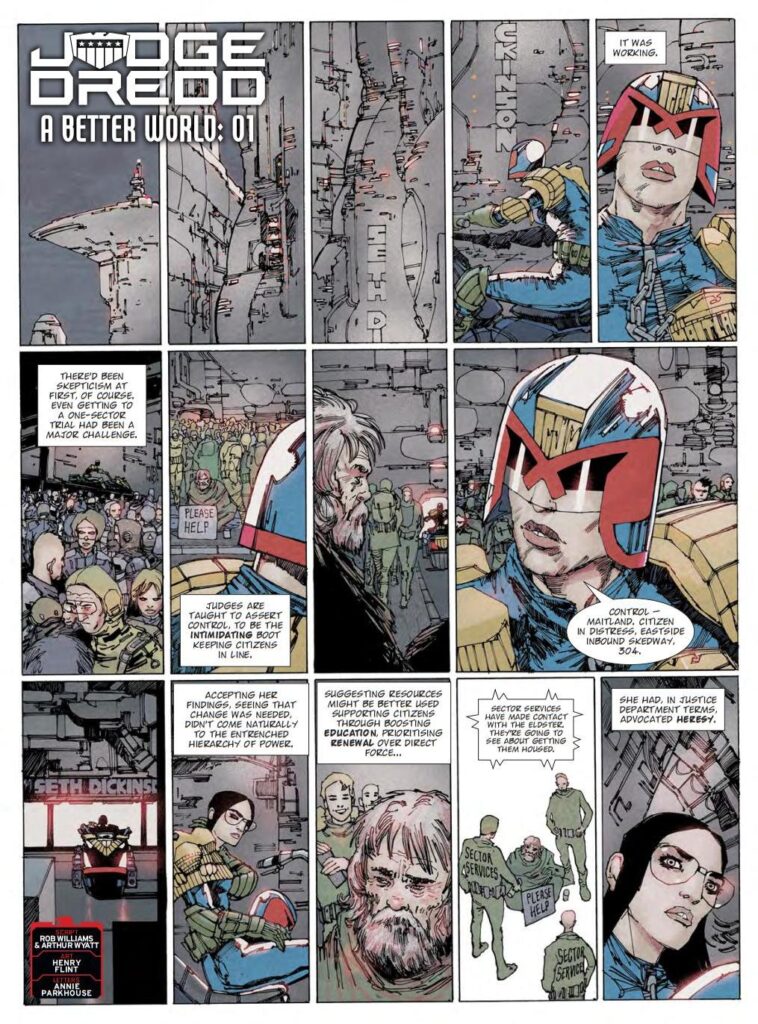
Although Judge Maitland was created by Al Ewing and Nick Dyer, you really rather made her your own, bringing a very different view of the world of Dredd to things, all culminating in A Better World, where she first saw everything she’d worked towards succeed and then, tragically, it all come to nought. Just what is it about Maitland that you were drawn to as writers? What made her so very special?
RW: I think I liked the idea of an Accounts Judge being at the heart of stories. It’s so opposite the cliché of the hero. And she was a good soul. She wanted to make changes and to fight entrenched systems and make things better for the citizens. The moment she runs her modelling and sees that crime drops if they put more money into education and social projects, and away from policing, she’s doomed, really. The tragedy of the idealist. That was a storyline that had the potential to really make a readership feel things.
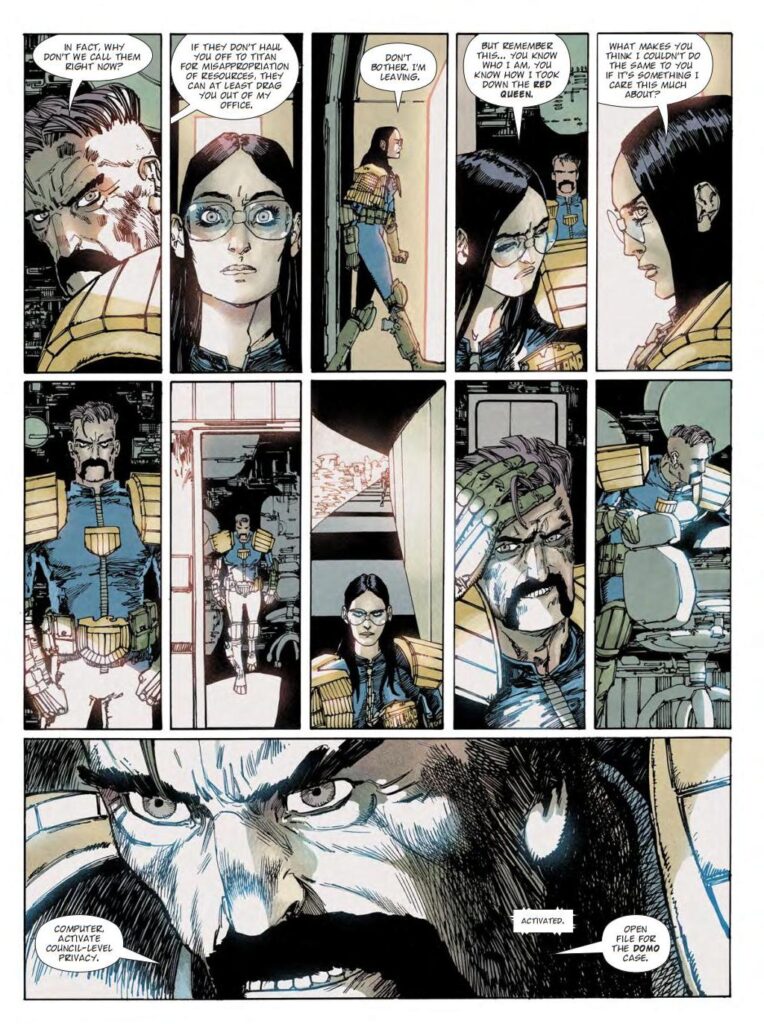 A Better World was a brutal and nasty thing – you build her up, you make her a true hero, going out on a limb to do the right thing, bringing MC-1, the citizens, and the readers some hope, and then you brutally cut her down, bringing down the hopes and dreams of both the cits and the readers in one shocking moment. Seriously, have you no heart? Was there never a moment where you thought of the readers and considered giving Maitland the win?
RW: No, because there’s no drama in that. If we’d followed through and had Maitland change Dredd’s world for the better, that would be the end of Judge Dredd as a comic strip. And there was so much power and anger and pathos and rage to be mined for it not being a happy ending.
AW: Oh, we went over the final outcome quite a bit… I’m definitely the softy that wanted an out, and Rob is the one that was saying, “No, it has to be like that.” And really, the arc of the story being what it was… Rob was right.
 The villain of the piece in A Better World (and perhaps The New Future) is Robert Glenn – a nasty piece of new media work. All right-wing, in the business of making money by making people scared. I presume that was your intent with all this? To make it quite clear what we’re up against? Us pinko left-leaning liberals?
RW: Glenn is a bit Rupert Murdoch, a bit Donald Trump. He kind of looks a bit like Trump if you dumped that straw‑splatted hairpiece on top of him. Push the buttons of fear and anger to try and build your share price; don’t even give a seconds’ thought to the lives you’re destroying along the way. Dennis Potter called his cancer Rupert after Murdoch many years ago…
AW: He’s an amalgam of a lot of things. He’s very willing to play as an anti-establishment figure even when he’s propping up the establishment, which is a dynamic you see a lot in the real world but I think is a bit new to Mega-City One.
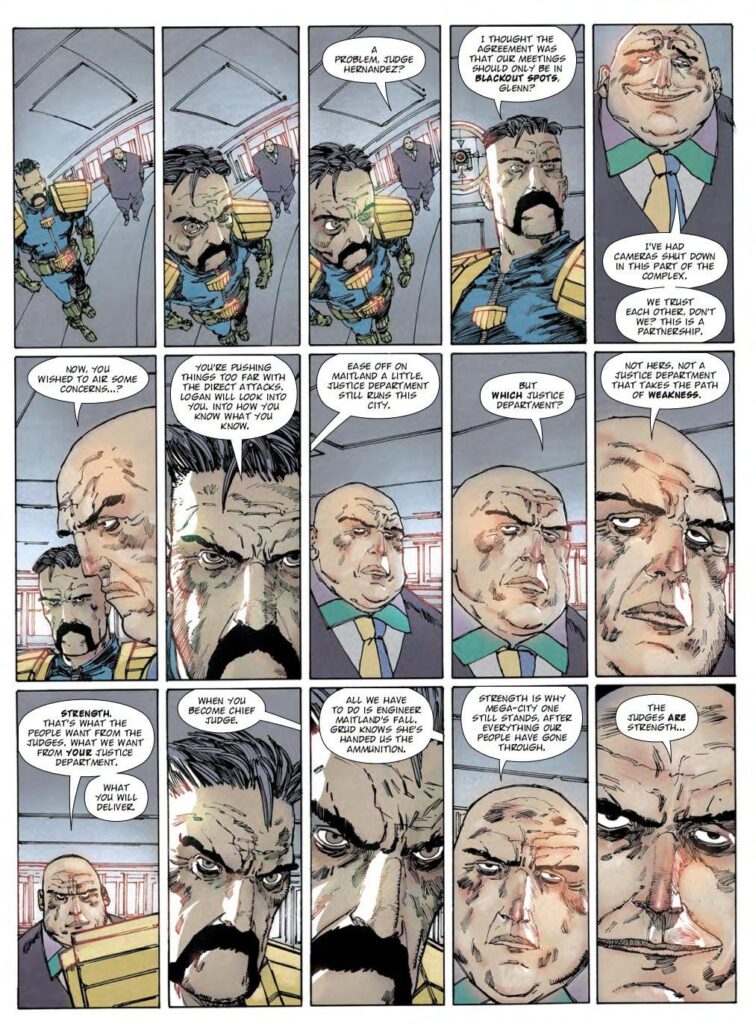
Anyway, A Better World was, you’ll forgive us the praise here, an absolute triumph of a thing. Dredd a bit player in a bigger story, a far more important story. It’s a very political story, dealing with all manner of important and relevant things.
Is it the sort of thing that you imagined would get so very political when the first ideas came to you, or did things develop organically out of the writing?
RW: I think once the idea came to do the ‘defund the police’ storyline, that was an inevitable conclusion. Arthur can answer this better than me but he was living through some of the protests that were happening in Portland, Oregon, at the time. And the times we’re living through now, both in the States and in the UK – the themes of ‘A Better World’ are battering us daily. It was all just there.
AW: A benefit of doing a long multi-part story arc with a few gaps has been we’ve had a bunch of time to thrash out how exactly we wanted to get to where we were going. But as I say, the final destination got locked in quite early. The big surprise to us was that after our big mic drop movement we found ourselves really wanting to go back for more. And it turned out we’d left ourselves quite a lot to work with.
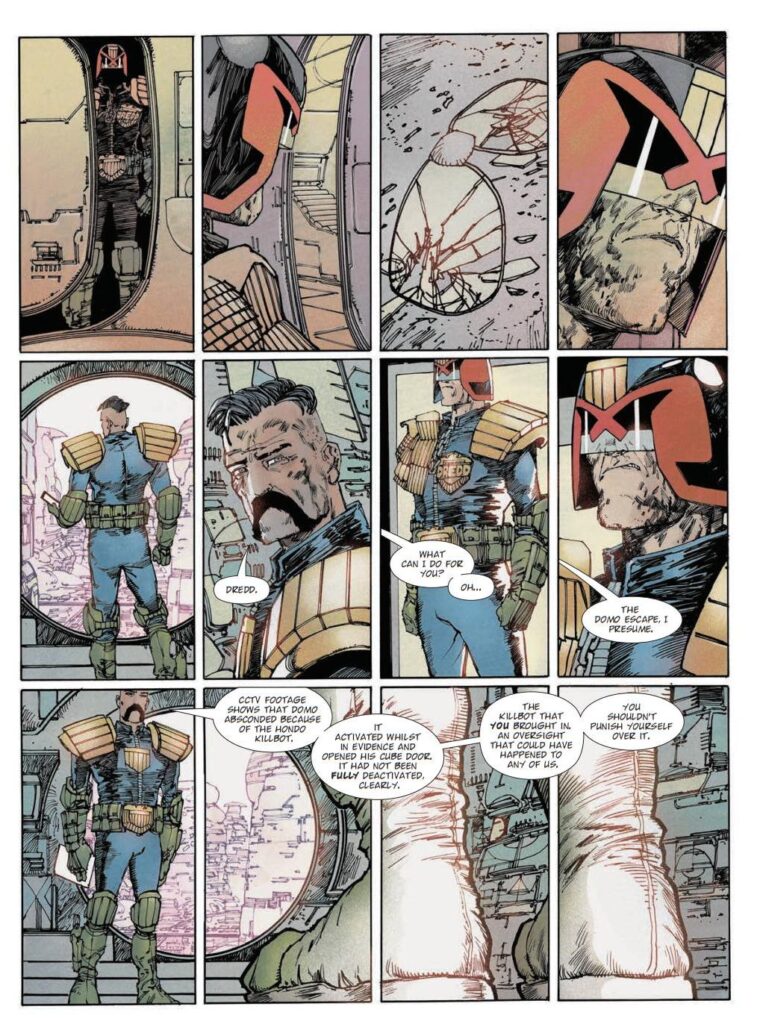
With A Better World all done, you’ve left it nearly two years to follow it up with The New Future. Was this a deliberate thing or just a question of timing?
AW: This and that. We had to figure out what we wanted to do, and of course we wanted to have Henry, and 2026 has turned out to be quite a year for big stories with The Oubilette running right before ours.
RW: Timing, really. We needed a moment to let it breathe rather than jumping back in. Henry was drawing And To The Sea Return so we were waiting for him. There was no way anyone else could draw The New Future. If Henry hadn’t wanted to do it, we would have binned it. He’s so integral to this storyline in terms of storytelling delivery, tone, aesthetic. And it took Arthur and I a bit longer to write this one. We had no pressing deadlines so it all breathed a little more.
I think it benefits from having time for people to digest A Better World in Graphic Novel form. A bunch of people don’t buy 2000 AD ever week (shocking, I realise), but did read the story in GN. We’ve given it enough time to make it seem worth waiting for. And there’s some serendipity in the timing as we’re finishing The New Future right on the cusp of Dredd’s 50th anniversary. That gives the storyline a sense of import and gravitas.
Although, of course, you did do a slight return with Silence in Progs 2401-2402 and Soft in Progs 2414-2416 – how much of that will be reflected in events in The New Future?
AW: They’re basically the equivalent of the build to The New Future, setting pieces in place for the main event…
When we’ve spoken before about The Pitch (you can find that interview here), part of the initial set of stories that set Maitland off on her journey to make that Better World, we talked about how that real time passing mechanism allowed you to develop a long-running storyline over years in an organic way, one that worked to your advantage.
Here, we’re two years post Maitland. What’s happened in the interim?
AW: We get a little of that in the Prologue and in Soft/Silence… Dredd’s in a situation where he’s almost in a Cold War with the head of Street Div, and Glenn is still out there manoeuvring. Somewhere out there there’s got to be the final pieces of the puzzle to make the case stick, but until he gets it, it’ll be a continual frustration.

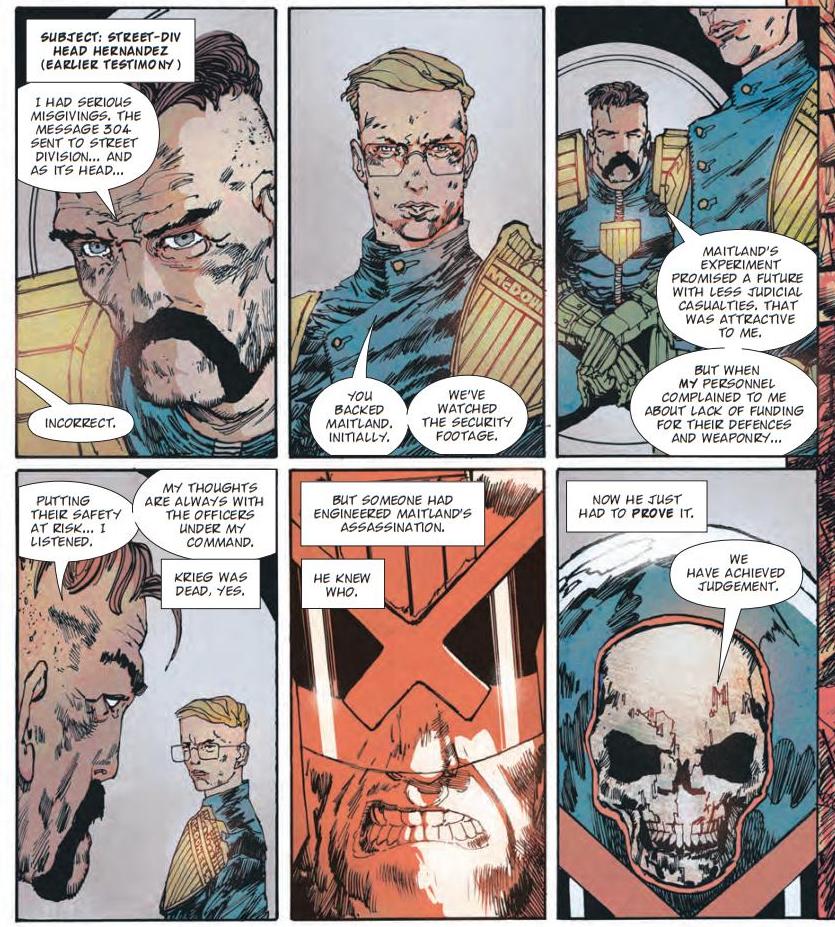
Thus far, we’ve seen both the Prologue and the first part of The New Future. With the Prologue and the SJS Judges interrogating the major players post-Maitland, was it something to act as that bridge between series, to look back, establish roles, and move us on?
RW: It’s a little bit of a ‘the story so far’ reminder to readers to remind them of what happened in A Better World but it also sets up our main players and lays the ground for a couple of major plot points to come. And Henry delivered it beautifully. What he does with colour in the prologue episode is awards-worthy all on its own.
AW: it’s basically six pages doing an amount of double duty as recap for some recent stories, set up for the new story, a general thematic statement and (hopefully) a neat little self-contained piece for people who only pick up Prog 2500. Feeling like we probably succeeded on all counts from the reaction.
Rob, in particular, this isn’t your first time dealing with the SJS — I’m thinking back to Control — what is it that makes them just such terrifying protagonists?
RW: They’re the bogeyman for Judges. And no one really knows what goes on in that SJS Headquarters that Chris Weston drew in Control. They’re like the Spanish Inquisition in terms of their ability to just show up and haul anyone in for questioning – even Chief Judge Logan, as we see in the Prologue. They’re a scary wild card for our narrative.
 Back to the Prologue, as far as those major players are concerned, each has their roles to play here — and you’ve teased us plenty of little moments in that Prologue for each during the SJS Judges’ interrogations. We’ve got Logan’s clone program, SJS Judges’ revelations as to how they see Beeny, and then we have Dredd and Hernandez, seemingly circling around each other here, destined to clash in The New Future.
AW: It seems like it might be… events may intervene.
RW: Partially, yes. We’ve seen enough times in the past what happens when Dredd seeks out justice. But that always took place within the framework and structures of Justice Department. What if those structures change? (No spoilers). Where does that leave Dredd?
The Prologue does exactly what its intended – it sets the tone for The New Future, brings in the main players, has the SJS Judges quickly get to various pressure points — Logan’s weakness, Beeny’s naïveté when it comes to the politics of MC-1, Dredd’s seeking of revenge, and Hernandez’s ambition and compromised position.
How much of all that will you be exploring in A Better World?
AW: It certainly sets up quite the menu for banquet… there might be a few suprise reveals along the way, though.
[Now here we also bid farewell to Arthur. Again, Tharg’s will be done, and when he says a script droid needs to report in… well, that script droid must report in. And Mek Quake stood in the background… just being menacingly ‘there’ is a very strong reminder of just what happens to the droids who delay responding to a directive from Tharg!]
Let’s talk about the writing now, and specifically how the two of you work together. Just how does it work?
RW: Arthur and I email ideas back and forth and occasionally jump on a Zoom to discuss. We’ll knock the plot into some sort of shape that way. Then we break that into the structure of the story in a breakdown – Act One, Act Two, etc. Then, when it gets to episodes, we break them down into what story beats appear on each page in a ‘Zero Draft’. So, plot-wise, we’re following this character on page 1, and this is what has to happen there to push the narrative forward. Then each 6-page episode will have, say, me writing first draft script on pages 1-3 and Art first draft on pages 4-6. Then we swap script pages back and forth and will tweak things a bit. Hopefully that way you get some form of ‘solo’ voice on the page, and you can’t recognise a Rob bit or an Arthur bit. My memory’s terrible. Very often I’ll read the finished story in the Prog, like a bit, and can’t recall if it was mine or Arthur’s.
When you’re working with Henry as your artist on the story, do you bring him in at all on the plotting stage, or is it simply that you get the script approved by Tharg and send it over to him?
RW: Yup, Henry gets finished scripts, and just delivers his pages, breaking our script down as he sees fit.
It’s pretty amazing what he delivers. He’s such a brilliant visual storyteller; he has full license to break the page down as he sees fit. We know our narrative beats will be there, and he’ll land the emotional/powerful moments. He’s something of a savant on this comics thing.
Yes, when you say ‘he has full license to break the page down as he sees fit,’ you really do mean that – you sent over the script to The New Future Part 1, where we get this…
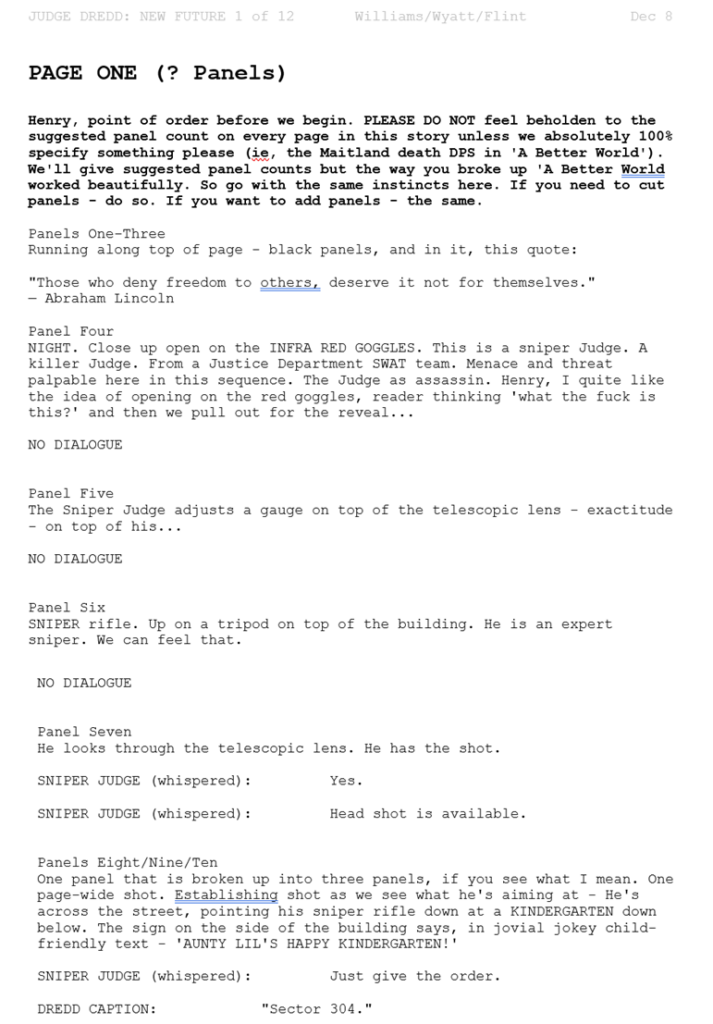
Essentially, it seems like Henry has a look at the script, sees a suggested panel layout, and just completely ignores it, expanding out the page to whatever number of panels he sees fit. And the thing is, it always works – such is the greatness of the man.
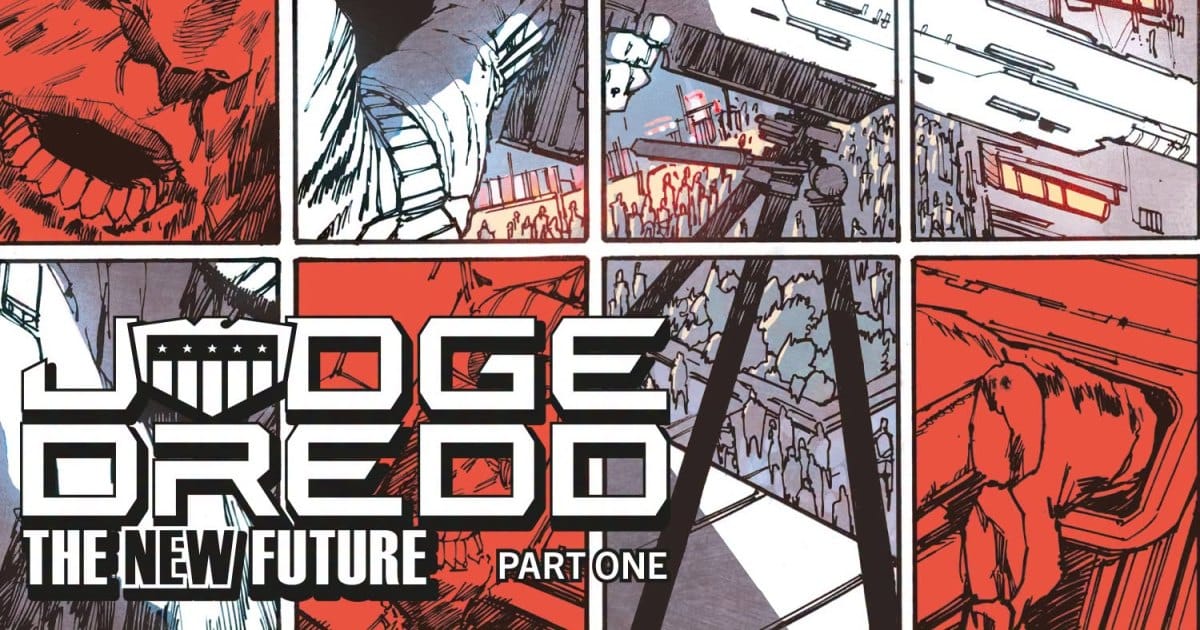
The first page of The New Future Part 1 in Prog 4501 is a case in point. Your script called for 10 panels for the page. Lo and behold, it comes back as a quite magnificent 25-panel page...
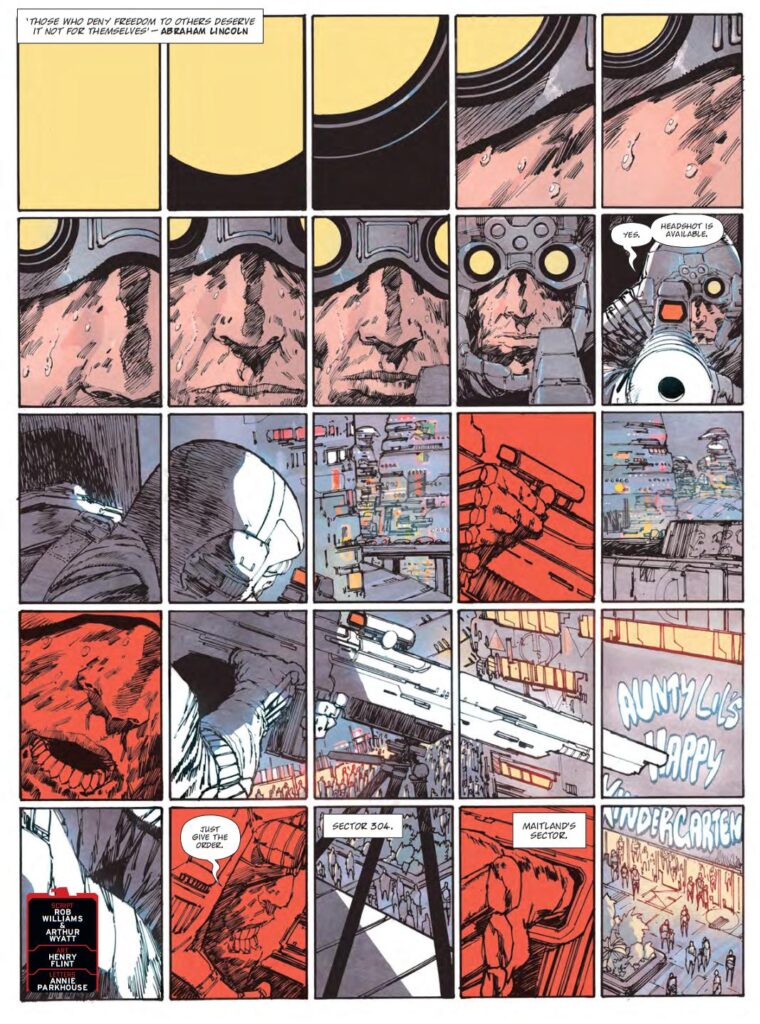
All the script elements are there, as you both described, but Henry’s just taken it and elevated it, giving it perfect story beats, maximising the tension and intrigue you were aiming for.
RW: Yup. Very often Henry takes the idea of what we’re asking for, and he adds/subtracts to sell it his own way.
My favourite page in And To The Sea Return, where Dredd experiences this vision of the first settlers coming in to land in America – I think I suggested a 12-panel page there. Henry did it in 20, and added some colour/horror flourishes in a few panels. He’s taken the script, totally delivered what it asks for, but added some Henry Flint genius to it, which enhances it hugely. If an artist wants to elaborate a script, sometimes it can be to the detriment of the story. Henry never once ignores the story. He nails the major storytelling beats and builds upon them. He is genuinely one of the best we have in comics, for me.
[And here’s that very page – Henry Flint’s art on Judge Dredd: To The Sea Return – Prog 2458]

Obviously, given that rider added into the script, you’ve absolutely no problems with what Henry does with your scripts. But when you get the finished art back from Henry, playing wonderful havoc with your panel layouts, there’s the small matter of the fact that, in adding in so many extra panels, in changing the beat of the script he was provided with, the captions and the speech bubbles need adjusting to this new finished page. How does that work?
RW: Henry does that, pretty much. He breaks down our scripts and takes our dialogue and partitions it across different panels, then sends lettering notes. He’s a monster.
Having worked with Henry for quite some time, how would you describe what he brings to your stories, and where do you reckon he ranks amongst the greats who’ve worked on Dredd?
RW: Oh, Henry’s up there with the best 2000AD have ever had. It’s funny, because you can kind of see the influence of Kev O’Neill and McMahon and Carlos – probably Brendan McCarthy too. So his artistic DNA is very 2000 AD. Although with A Better World especially, you could see Frank Miller and Lynne Varley’s influence in there too. A bit of Moebius. None of these are remotely bad things.
For me, he’s one of the best talents in comics, full stop. He’s kind of a storytelling savant. He’s throwing this insane architecture and production design and lighting and costumes and graphic design at you on every page – but, and this is the most important thing, it’s never to the detriment of the storytelling. The narrative and emotional beats are always 100% clear and powerfully conveyed. So that’s the full deal, in comics terms. Only the very best can do that.
If DC had teamed him with a Scott Snyder or somesuch on a major Batman graphic novel, he’d be lauded in the industry the way a Jock has. But Henry’s always largely worked for 2000 AD, so he’s remained a bit of a secret. It’s not hyperbolic to say that he deserves Eisner and Harvey Award recognition for his work here. I genuinely feel lucky to work with him.
[Oh yes, we agree wholeheartedly with all that – but, and we can’t say this strongly enough, HANDS OFF, Henry’s ours, all ours!]
One brilliant bit of what we assume was Henry adding to the script happened in The New Future Prologue, where Henry’s described it to us, as ‘We’ll skip the prologue as that’s just a 3×3 grid as in the script.’ But that’s downplaying the wonderful extra he doesn’t mention, where, to the right of that 3×3 grid, there’s the added brilliance of the Justice Department Eagle gradually becoming blood-soaked. Are we right in thinking that was something Henry added, symbolising what’s to come in The New Future?
RW: I think that was a Henry addition. Yeah, it’s terrific. The incremental page-by-page move of more and more blood running down the golden eagle.
And here you go, that perfect bit of Henry’s artistic additions, the Justice Department eagle in the pages of the Prologue to The New Future, foreshadowing what may be to come…
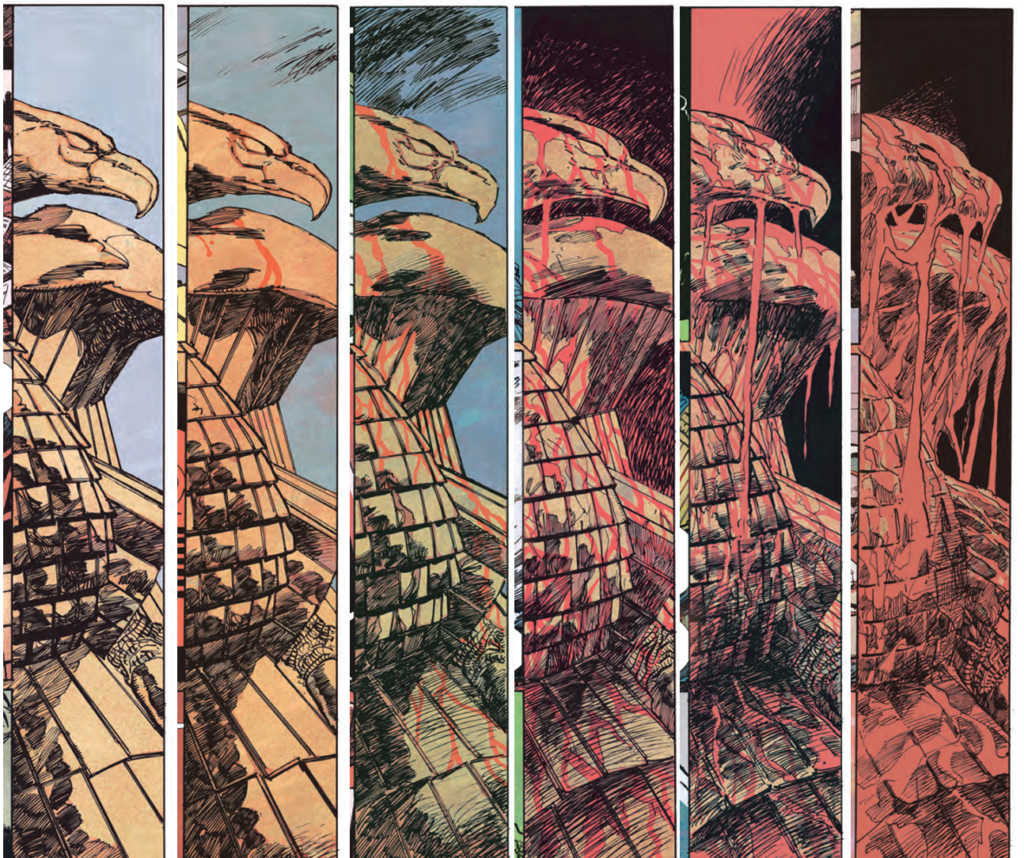
With The New Future, and we’ll hopefully be talking to Henry about this when he’s actually finished the small matter of drawing the pages of the story, he’s doing incredible things, just playing with the idea of how to break a page down into panel beat, quite magnificently. At this point, the best example of this is with The New Future – Part 1, where Henry takes your initial 10 panels and delivers 25, perfectly done, absolutely sticking to the story, but adding so much. It’s just an example, and there are so many, of an artist just supremely confident in his craft, his art.
What have you to say about what Henry’s doing with realising your script?
RW: We’ve leant far more into Henry’s approach with our scripts this time. He kind of opened the floodgates for us to go ‘oh, we can write 12-panel pages can we?’ And we had to keep an eye on just how much dialogue we were writing. For this to work, Henry needs the room to expand and play with what we deliver. We can’t over-condense it. But it all looks and reads immaculately. Our job is to write a gripping story with twists and turns and big emotional beats. I think we’ve done that.
 With something like A Better World and The New Future, where you’re potentially bringing huge changes to the status quo of Dredd and MC-1, do you think about the possible ramifications of what you’re doing as regards the bigger Dreddworld when you’re telling your tale? Or is it a case of publish and be damned?
RW: All this runs past Matt Smith, our editor. For this sort of story to have stakes, certain things had to change in the structures of Dredd’s world. It’s too easy to go ‘and all the toys go back in the box’ at the end, like nothing happened.’ Matt’s allowed us to do that this time around. Matt’s the conduit! It all runs through The Mighty Tharg.
And as for the future of Dredd, as we approach the 50th anniversary of the character, what is it that makes him such an enduring character?
RW: Dredd, as a strip, reflects the times and predicts what’s coming. That makes it always relevant. That’s why he’s sustained for 50 years – which is pretty wild for a ‘Dirty Harry in the future’ somewhat throwaway idea. But it’s testament to the work and the talent of those who constructed this world that it remains so rich.
And finally, what’s coming up from you all as the next project?
RW: A few things I can’t talk about yet. I do have something extremely exciting coming for Dredd’s 50th Anniversary, with some brilliant collaborators. More on that when we’re able.
Ooooh, teasing us there! Like Rob says, more on that to come!
Now we shall leave you with a little peek into the future, with this from Judge Dredd: The New Future Part 2, in 2000 AD Prog 2502, out next week, as the legacy of Maitland’s vision lies in the hands of journalist Oswald Roth…

And that was where we had to leave it. Indeed, as we started talking about just what those ‘extremely exciting’ things were for the Dredd 50th Anniversary, Mek Quake took a couple of steps forward and simply cleared his throat. Never has so much been threatened by so little. So at that point, we said goodbye to Rob.
A huge thank you to Arthur, Rob and, albeit fleetingly, Henry here for this mega-interview.
Judge Dredd: The New Future began with the Prologue in 2000 AD Prog 2500 and continues weekly. Seriously, this is one you can’t miss out on.
And of course, your required reading here is Judge Dredd: A Better World. It’s the brilliant tale that leads into The New Future, where Rob, Arthur and Henry gave us one of the truly great modern Dredd tales.
