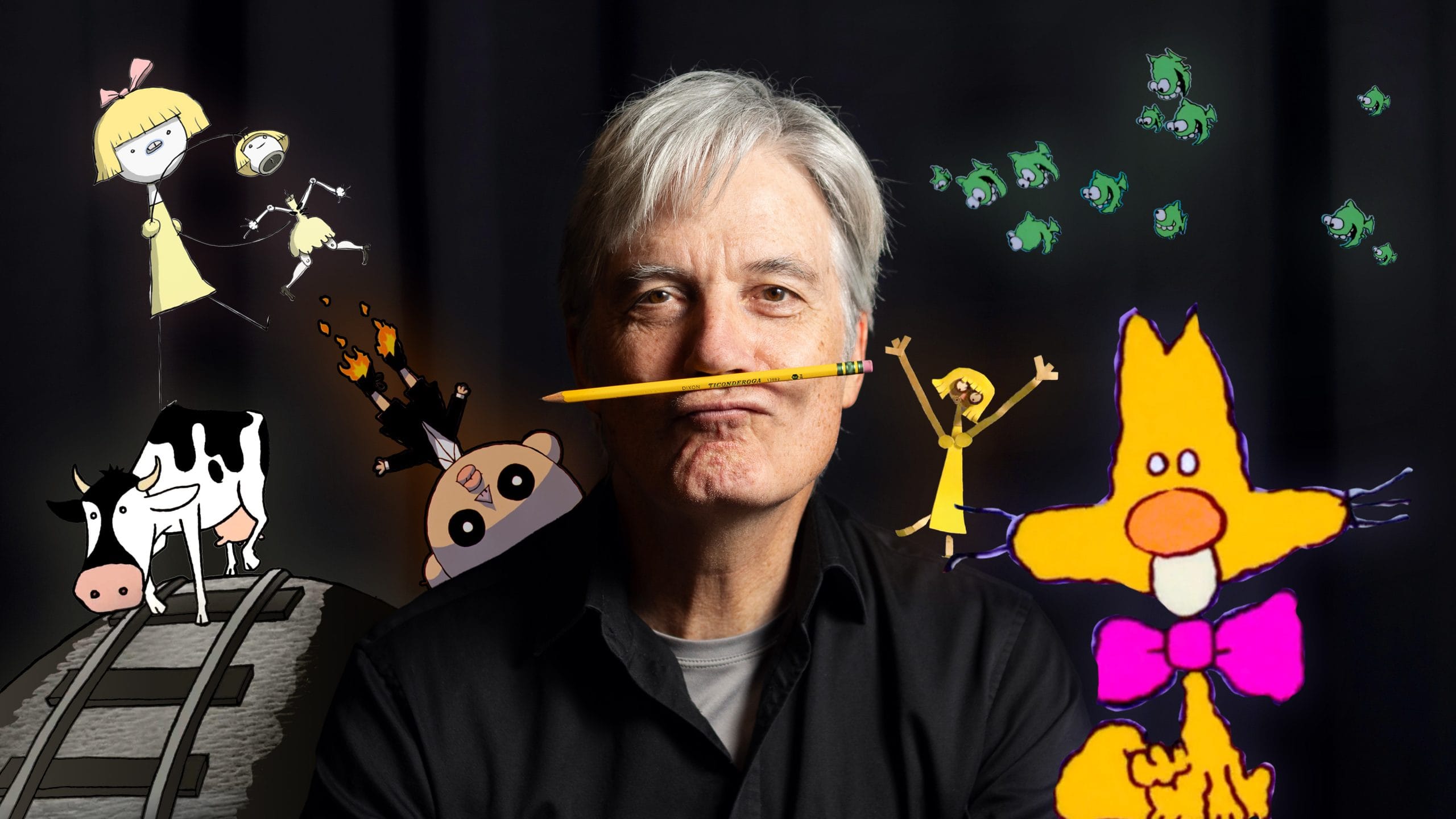
These few words alone could sum up the five films Cordell Barker made at the NFB. Five characters who are not always the protagonists, but who invariably act as disruptive factors, setting things in motion and sometimes serving as a point of contrast. Let’s take a closer look.
a cat
The cat came back (1988) tells the story of old Mr. Johnson, who one day opens the door and finds a little yellow cat in a pretty basket at the entrance to his house. He doesn’t even suspect how his life is about to change. At first, he is completely captivated by the adorable kitten. But the allure soon wears off when the cat breaks his favorite rattle and quickly decides he can’t stay. The cat, however, has other ideas. Despite the old man’s increasingly desperate efforts to get rid of his furry problem, it keeps reappearing, hence the film’s title. This gives us our first example of a character whose role is to set the plot in motion.
Inspired by a popular tune whose catchy chorus you’ll surely find yourself humming after the movie, Barker’s first animated short was a huge hit with audiences and critics alike. It won over 15 awards in Canada and abroad, including an Oscar nomination, and quickly became a classic in our collection. Not bad for a self-taught filmmaker who was convinced his film was terrible and would soon return to construction work! The film effectively launched Barker’s career as an animator. Originally from Winnipeg, he started at Kenn Perkins Animation before joining the NFB’s Winnipeg Studio animation unit in 1982.
The cat came back, Cordell Barker, provided by the National Film Board of Canada
The cat came back It helped Barker discover his signature style (simple drawings that allowed him to focus on rhythm, rhythm, and comic timing) and underlined the central role of music and humor in his work. Equally important, it allowed him to develop his own distinctive genre: hilarious, ostensibly kid-friendly stories with darker undertones that appeal to adults. All of these qualities would become distinguishing characteristics of his later work. Finally, it’s worth noting that the film bears the unmistakable stamp of the Winnipeg studio animation style of the era, with its scruffy, rubbery everyman and hyperbolic features: protruding teeth, bulging eyes, and a guttural, piercing voice.
a strange visitor
Strange invaders (2001) invites us into the world of Roger and Doris, a loving couple who lead a quiet life in their cozy home. One night, they are abruptly awakened by a strange visitor: a little boy. Could this be the answer to your prayers? That question is soon put to the test when their visitor takes over the house, wreaking havoc and destroying everything in their path.
Strange invaders, Cordell Barker, provided by the National Film Board of Canada
In his second film, Barker uses the same dramatic device as in the first, changing a tenacious cat for a disturbing baby. We find the same minimalist animation style and familiar settings; in fact, the couple’s house is very reminiscent of Mr. Johnson’s in The cat came back. His characters may be a little more recognizable as human this time, but they still retain Barker’s trademark exaggerated traits.

It’s a comedy, but decidedly for adults. Barker’s message is clear: the arrival of a child into a couple’s life is no different than an alien invasion, and children have a special ability to change things. You may have seen the frame flash by for a fraction of a second during the quick photo montage. The hidden message reads: “Cordell’s kids are evil. Dillon, Joshua + Jackson. Don’t stop this movie.”

Like its predecessor, Strange invaders It was a huge success with both audiences and critics, earning an Oscar nomination and winning more than 15 awards along the way.
a cow
While a cow wanders along a train track, a passenger train moves along the same track at full speed. When the train inevitably collides with the animal, the impact disorganizes its braking systems. Filled with revelers oblivious to what is happening around them, the train gains speed and soon spins out of control. How is all this going to end? This is the premise of Fugitive (2009), Barker’s third animated short. It is undoubtedly a metaphor for humanity’s carelessness in the face of imminent danger: a humanity marked by class divisions, conflict and injustice, hurtling headlong toward catastrophe.
Fugitive, Cordell Barker, provided by the National Film Board of Canada
As in his first two films, a single character, in this case the cow, acts as a disruptive element. In fact, the collision with the animal is what causes the engine to malfunction. But the cow also serves as a point of contrast: its wandering pace compared to the speed of the train highlights the fact that both the locomotive and its passengers are racing toward disaster.
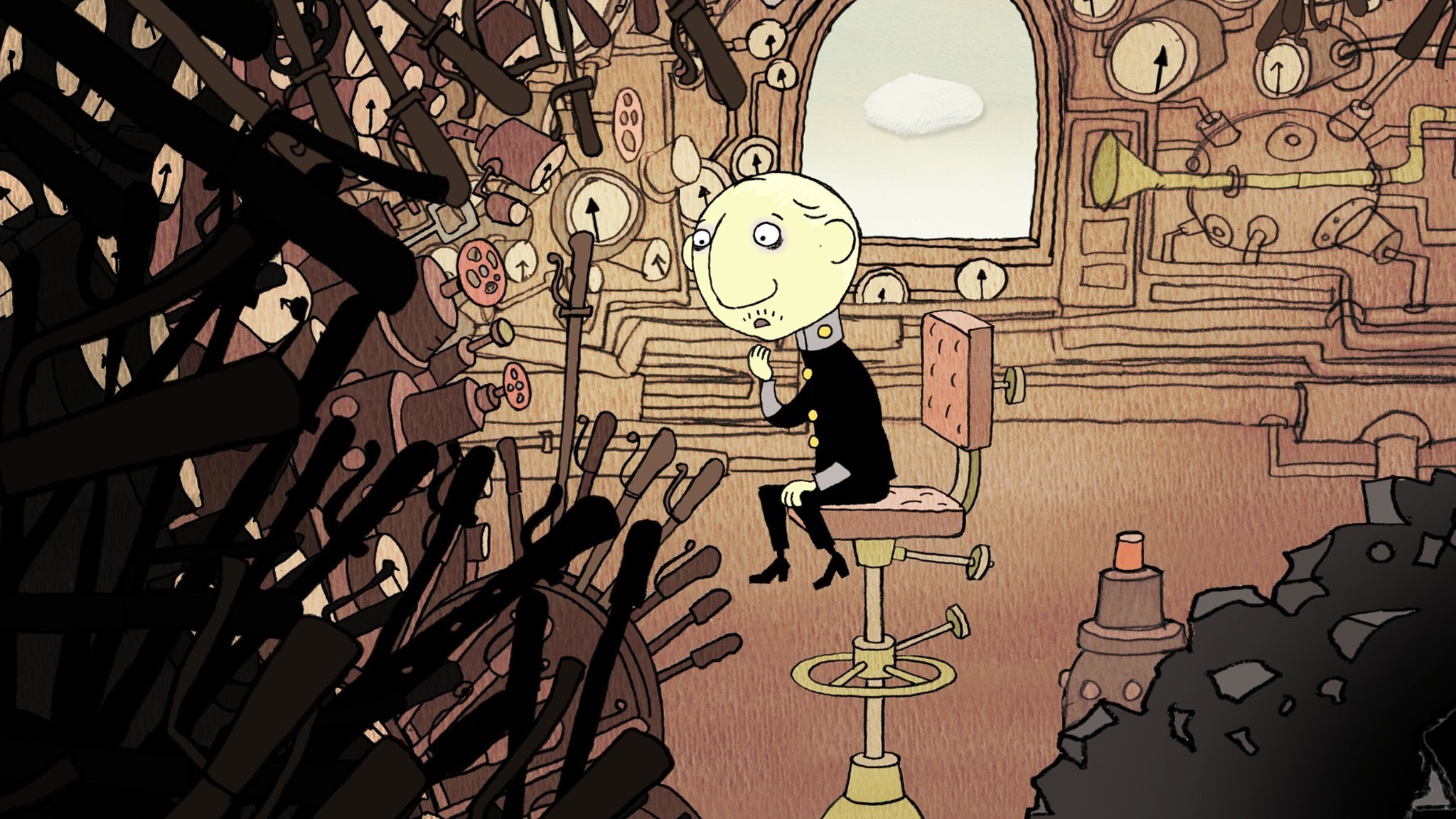
The subject matter may be serious, but Barker, as expected, handles it with humor and whimsy. The music by Ben Charest, composer of the animated film’s soundtrack. The Belleville Triplets (2003), nominated for an Oscar for Best Original Song, leans toward the absurd, establishing the film’s comedic tone while dictating its pacing and tonal shifts. Barker’s animation, this time a little less cartoonish, It matches perfectly with the soundtrack.
Fugitive It received some 15 international awards, including the Petit Rail d’Or for Best Short Film in the Directors’ Fortnight section of the 2009 Cannes Film Festival.
a frog
With If I were God… (2015), Barker embarks on something more personal: a true story, if the opening credits are to be believed (Barker himself narrates the original English version of the film). In any case, we meet 12-year-old Cordell in his classroom, lost in a reverie. He tells us that he feels “like a god.” Feeling the first hints of adulthood, he senses that he will soon be able to do whatever he wants, a thought that fills him with a heady sense of power. He doesn’t yet know what he will become, only that it will be something impressive. Tasked with dissecting a frog, he suddenly realizes that he has the power of life and death over the creature. He can bring him back to life at will, something only God can do. Could it be God? If he were, he could rid the world of evil and get anything he wanted.
If I were God…, Cordell Barker, provided by the National Film Board of Canada
In this darkly funny coming-of-age story, it’s the frog who acts as the unlikely catalyst. After all, isn’t it the dissection of the frog and its subsequent reanimation that gets young Cordell’s imagination racing?
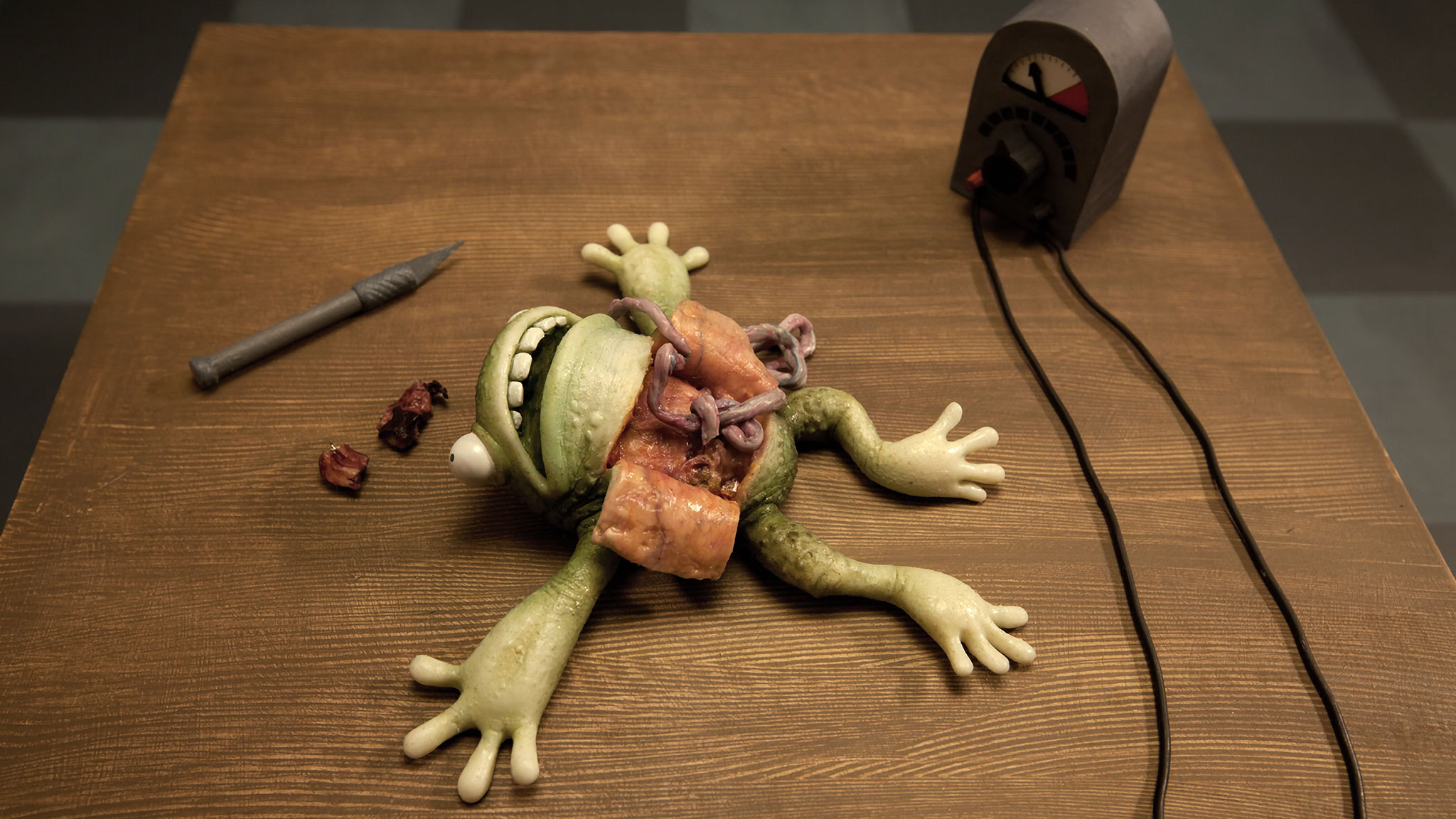
Barker’s fourth film has all the hallmarks of his previous work: anarchic humor, impeccable comic timing, music in a key role, and a story that appeals to both children and adults. This time, however, he uses a new technique: stop-motion puppet animation, which he combines with 2D animation. Animators Sylvie Trouvé and Dale Hayward handle the puppets, while Barker draws the 2D sequences.
If I were God… It won multiple awards, including the 2017 Gémeaux for Best Animation.
a girl
In the opening sequence of Good luck to everyone (2025), Barker’s latest release, a girl plays with her toys. Suddenly, a small robot approaches her. He grabs it, rips off its head and replaces it with his doll’s, plays with it for a while, then tosses it aside. The robot gets up, leaves the house and leaves to explore the outside world. There he begins to grow and eventually becomes a giant. It’s not long before he poses a threat to everything around him. Meanwhile, a fragmented voiceover of scientific and philosophical reflections on the ramifications of AI plays in the background. Has the little girl, without knowing it, created an intelligent machine equipped with consciousness, capable of destroying us? This fantastical, fun and disturbing story offers a reflection on AI, our latest technological “toy.”
Good luck to everyone, Cordell Barker, provided by the National Film Board of Canada
This time it is neither a cat, nor a strange visitor, nor a cow, nor a frog, but a little girl who sets the chain of events in motion by replacing the robot’s head. However, like the cow in FugitiveIt also serves as a point of contrast, his childish perspective versus the more articulate opinions of scientists and philosophers. This may well reflect the viewer’s own position, caught between the two.
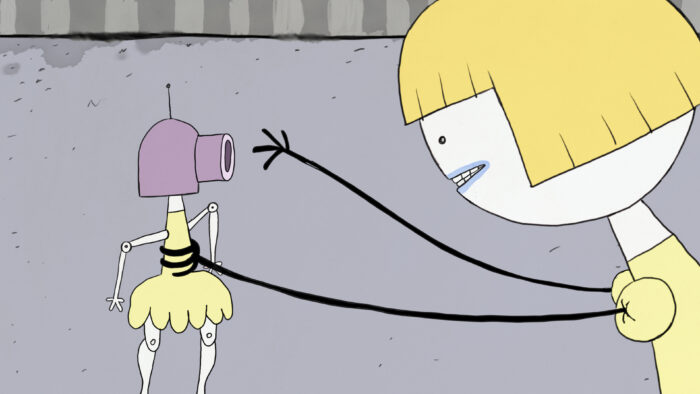
Good luck to everyone marks a turning point in Barker’s work. Although it returns to hand-drawn animation and its characteristic offbeat humor, it also incorporates documentary elements for the first time. Music also plays a less prominent role. More importantly, Barker raises difficult questions about how we will use AI in the future, questions we cannot answer. The film suggests a future that is both uncertain and disturbing. In fact, doesn’t its title come from a radio speech given by Queen Elizabeth II (then Princess Elizabeth) in 1940, at the beginning of the most devastating war in history? In the end, Barker seems to wish us all luck in a world ruled by AI.
I invite you all to watch the film, newly available on our website. And if you haven’t already, you can watch his other four films on our channel. The Cordell Barker Collection.
A brief message from our Marketing team
Our dreams are about to come true! Cordell is currently finishing work on a Christmas-themed animated piece for the whole family: a 30-minute story about a main character who comes straight from the South Pole. GIVE CLAUS It is scheduled for release in December 2026. Stay tuned!